
Fullerton vs Brea Communities Empty Nesters: 7 Essential Tips for Rightsizing in 2026
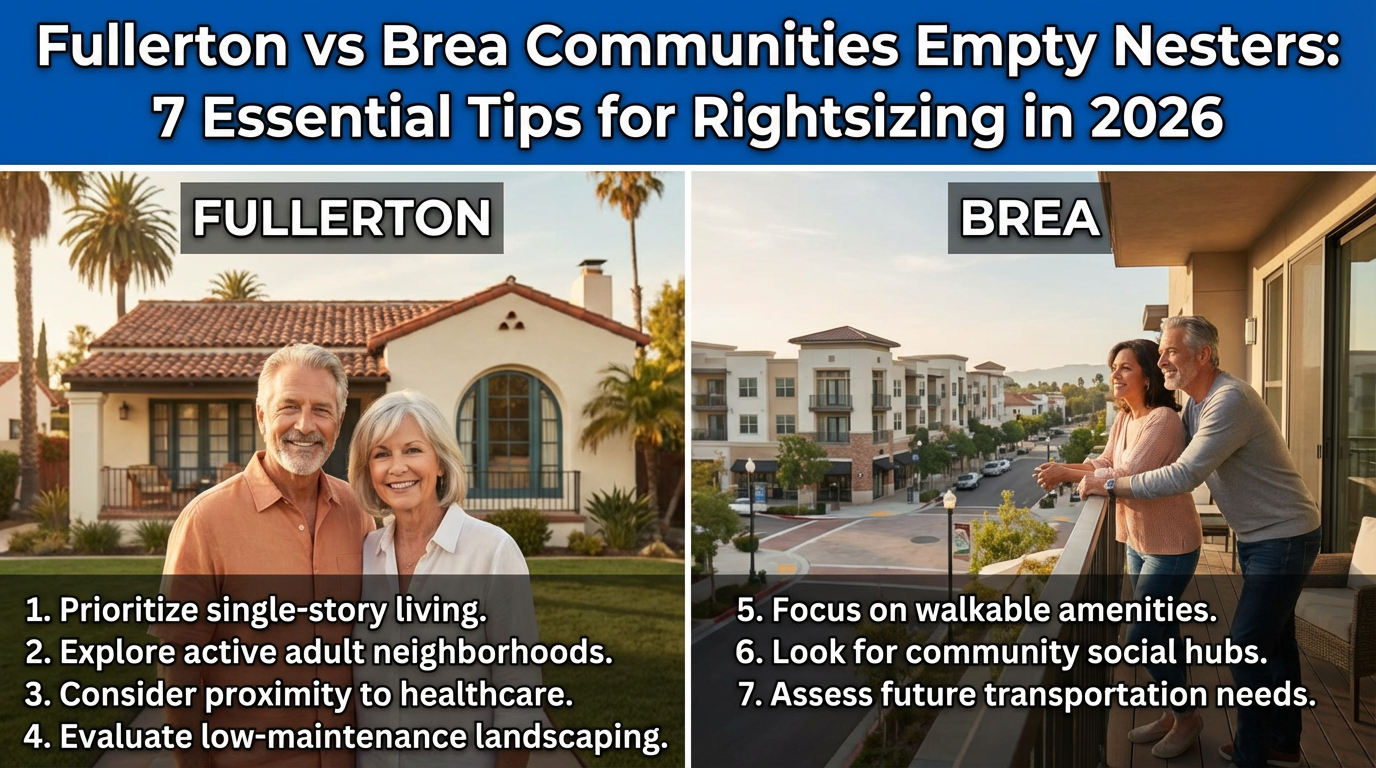
Fullerton vs Brea Communities Empty Nesters: 7 Essential Tips for Rightsizing in 2026

Expert Comparison of 55+ Communities, Pricing, and Lifestyle Options
Quick Answer
The Fullerton vs. Brea Communities Empty Nesters comparison shows that Fullerton offers lower entry prices ($953,000 median), Walker’s Paradise walkability (97/100), and CSUF lifelong learning. Brea provides a gated 55+ community, Buena Vida ($700k-$1M), a higher median age (39.6 vs 36.1), and a small-town feel.
The biggest challenge facing empty nesters in Fullerton and Brea right now isn’t finding a 55+ community. It’s figuring out which investment protects your retirement savings while delivering the lifestyle you’ve earned. You’ve spent 30 years maintaining a 2,500-square-foot home. The kids are gone. Property taxes keep climbing. And suddenly, you’re wondering if downsizing makes sense.
Here’s what most realtors won’t tell you: the $147,000 price difference between Fullerton and Brea medians isn’t just about money. It’s about walkability versus gated communities. University-adjacent lifelong learning versus country club amenities. Walker’s Paradise versus golf course access. With 190 closed transactions across North Orange County since 2012, we’ve seen firsthand how empty nesters approach this decision and the costly mistakes they make when they focus solely on monthly HOA fees.
The tradeoff here is simple. Fullerton delivers lower entry costs and intellectual engagement through programs at California State University, Fullerton. Brea offers age-restricted gating and structured social activities at Buena Vida at La Floresta. Both communities provide legitimate paths to comfortable retirement, but they attract fundamentally different buyer profiles. What we’ve noticed in this market is that buyers often choose based on what sounds appealing, then regret overlooking practical factors like healthcare proximity, crime statistics, and actual resale velocity.
The Real Problem Empty Nesters Face When Comparing Cities
You’ve attended open houses in both cities. You’ve downloaded HOA budgets. You’ve calculated property tax savings. But you’re still stuck because nobody addresses the uncomfortable truth: your choice of retirement community determines your lifestyle, healthcare access, and financial security for the next 20 to 30 years.
The challenge isn’t information scarcity. It’s information overload without context. Zillow shows 45 active listings in Fullerton between $800k and $1.2M. Redfin displays 23 in Brea within the same range. MLS data reveals median prices, days on market, and square footage. But none of these platforms answer the questions keeping you up at night: Which city maintains property values during recessions? Where will you find peers for social connection? What happens if you need assisted living in 15 years?
What’s interesting about the Fullerton vs. Brea Communities Empty Nesters decisions is that buyers typically focus on the purchase price while ignoring long-term cost differences. Brea’s cost of living is roughly 40 to 65 percent higher than the national average. 1 Fullerton’s expenses, while elevated, trend lower than Brea’s across groceries, dining, and utilities. For retirees on fixed incomes, a $3,800 monthly expense differential over 20 years equals $912,000 in cumulative savings, more than many buyers’ total home equity.
The demographic data reveals deeper divides. Fullerton’s median age sits at 36.1 years with a population of 141,000 and considerable ethnic diversity. 2 Brea’s median age reaches 39.6 years with just 47,337 residents and higher homeownership at 60.3 percent versus Fullerton’s 51.5 percent. 3 Translation: Fullerton skews younger with more renters. Brea offers established, affluent homeowners closer to retirement age. Your peer group availability differs substantially.
Why Traditional Approaches to City Comparison Fail
Most empty nesters approach the Fullerton vs Brea decision using a spreadsheet listing median prices, HOA fees, and school ratings. This methodical comparison feels logical. It’s also fundamentally flawed because it treats communities as interchangeable commodities rather than distinct lifestyle ecosystems.
The first failure point: focusing on current pricing without examining market trajectories. In December 2025, Fullerton’s median sale price stood at $953,000, down 2.0 percent year-over-year, while price per square foot increased 5.2 percent to $608. 4 Brea’s median reached $1,100,000, down 6.3 percent annually, with price per square foot declining 4.0 percent to $557. 5 The divergent trajectories signal market preference shifts. Fullerton is moving toward smaller, efficient homes (exactly what empty nesters buy), while Brea is experiencing price corrections after previous appreciation.
The second failure: ignoring differences in market velocity. Fullerton homes sell in approximately 45 days versus Brea’s 36 days. 4,5 But here’s the nuance: Brea homes receive an average of three offers with hot homes selling 5 percent above list price, while Fullerton averages two offers with 2 percent premiums. 4,5 When you need to sell for an assisted living transition, Brea’s competitive dynamics favor sellers despite longer marketing time.
| Market Factor | Fullerton | Brea |
|---|---|---|
| Median Sale Price (Dec 2025) | $953,000 | $1,100,000 |
| Year-over-Year Change | -2.0% | -6.3% |
| Price Per Square Foot | $608 | $557 |
| Days on Market | 45 days | 36 days |
| Average Offers Received | 2 offers | 3 offers |
| Hot Home Premium | +2% above list | +5% above list |
The third failure: overlooking walkability infrastructure. Fullerton achieves a Walk Score of 97/100, classified as Walker’s Paradise where daily errands don’t require a car. 6 This matters profoundly for aging populations. When you’re 75 and no longer comfortable driving at night, can you walk to the pharmacy, grocery, and restaurants? Fullerton’s downtown provides this autonomy. Brea’s suburban layout requires automobile dependence, leaving residents vulnerable when driving becomes unsafe.
The fourth failure: dismissing crime statistics as irrelevant. Brea experiences a total crime rate of 3,075.6 per 100,000 people, which is 45.13 percent higher than the national average. 7 Property crime hits 2,865 per 100,000 versus the national 1,760 per 100,000. 7 Fullerton shows a 2,479.3 per 100,000 total crime rate with higher violent crime (455.3 vs Brea’s 210.6) but lower property crime. 8 Your personal safety priorities matter, but most buyers never examine actual statistics before committing.
The Better Approach: 7 Essential Decision Factors
Instead of comparing cities on superficial metrics, successful empty nesters evaluate communities through retirement-specific lenses that predict long-term satisfaction. Here’s the framework we’ve developed through working with North Orange County buyers making similar transitions.
1. Age-Restricted Community Availability and Structure
Fullerton offers Morningside of Fullerton, a Life Plan Community at 800 Morningside Drive requiring entrance fees starting in the $300,000s and potentially exceeding $1,000,000 for larger homes, plus monthly fees starting at $5,078. 9,10 This model provides nearly all-inclusive amenities: meals at restaurants, housekeeping, maintenance, entertainment, transportation, pickleball, short-game golf course, heated saltwater pool, wood shop, and fitness center. 9,10 The critical advantage: lifetime long-term care included with priority access to the adjacent health center for assisted living, memory care, and skilled nursing. 9,10 Residents eliminate property taxes, HOA charges, real estate insurance, and most utilities. 9,10
Brea provides Buena Vida at La Floresta, a 55+ active adult community by Del Webb containing 267 homes built from 2016 to 2019. 11 Prices range from mid-$700,000s to mid-$1,000,000s with current average around $1,525,000. 11,12 Homes include 1,401 to 2,119 square feet with two or three bedrooms, attached two-car garages, and options for single-story living. Amenities include a clubhouse with a fitness center, a lounge, a ballroom, a catering kitchen, an exclusive outdoor pool and spa, pickleball courts, a demonstration kitchen, and programming for arts, crafts, and social events. 11 The advantage: traditional home ownership with age-restricted neighbors plus access to Whole Foods Market and restaurants within the La Floresta master plan. 13
The choice reflects retirement philosophy. Morningside appeals to affluent retirees seeking maximum financial and healthcare security with comprehensive services. Buena Vida suits active adults wanting gated community amenities while maintaining traditional ownership and autonomy. The price structures differ fundamentally: Morningside’s entrance fee plus monthly charges versus Buena Vida’s purchase price plus HOA fees.
2. Healthcare Infrastructure and Emergency Access
Fullerton benefits from St. Jude Medical Center, located 0.8 miles from Morningside, which was established over 60 years ago and is recognized as one of California’s most respected hospitals. 14,15 St. Jude achieves U.S. News & World Report recognition for best hospitals in rehabilitation and high performance in spinal fusion in 2025-26. 15 Additional access includes Ahmc Anaheim Regional Medical Center, 3.6 miles away. 14
. The facility offers a subacute unit for patients requiring short-term comprehensive inpatient medical care and rehabilitation. 16 For comprehensive hospital services, Brea residents access regional medical centers in nearby communities.
What most people don’t realize is that healthcare proximity becomes exponentially more important after age 70. Emergency response times, specialist access, and the convenience of routine care directly impact quality of life. Fullerton’s immediate hospital adjacency provides a measurable advantage for residents with chronic conditions requiring frequent monitoring.
3. Intellectual and Cultural Engagement Opportunities
Fullerton hosts California State University-Fullerton (CSUF), which awarded 10,903 degrees in 2023, making it the largest university in the city. 2 The university provides Osher Lifelong Learning Institute (OLLI) at CSUF, offering educational courses specifically designed for older learners. 17 CSUF’s Center for Successful Aging offers structured exercise programs for adults aged 55 and older, including functional fitness, water-based aerobic training, and balance enhancement. 18 These university connections create unique intellectual engagement and cultural events unavailable in most retirement communities.
Brea’s intellectual opportunities center on municipal programming through Brea Senior Center offering free membership with recreational and educational activities, fitness classes, and on-site lunch programs operating Monday through Friday 8:00 AM to 3:00 PM. 19 The city provides diverse programs through Brea Recreation Department emphasizing community togetherness and celebration. 20
In our experience with North Orange County empty nesters, proximity to university programming dramatically increases engagement rates. Buyers who initially dismiss lifelong learning often become the most active participants once exposed to low-cost, high-quality OLLI courses. Fullerton’s university connection represents a measurable lifestyle advantage for intellectually curious retirees.
4. Recreation Infrastructure and Active Lifestyle Support
Fullerton maintains over 28 miles of trails accommodating various experience levels, including walks specifically designed for seniors. 21 Hillcrest Park features hiking trails, recreation trail system, lake, paleontology museum, fishing, interpretive center, and extensive picnic facilities. 22 Fullerton Community Center at 303 W. Commonwealth Ave serves as hub for recreational programming with senior staff leading Monday morning hilly trails at faster pace and Wednesday level trails at casual pace, with 6-week courses priced at $20. 21,23 The center operates 7:30 AM to 8:00 PM Monday through Friday and 8:00 AM to 3:00 PM Saturday. 23
Brea offers Arovista Park spanning 14.84 acres with play areas, barbecues, picnic tables, ball diamonds, soccer fields, volleyball courts, amphitheater, and basketball courts. 24 Brea Creek Municipal Golf Course provides popular nine-hole community golf course with driving range open daily 6 AM to sunset. 24 Birch Hills Golf Course offers redesigned executive 18-hole course with new greens, tees, and lighted driving range. 24 Carbon Canyon Regional Park spans 131 acres with hiking trails, tennis courts, and a small pond accessible from Carbon Canyon Road. 25
The trick is to evaluate not just facility existence but actual utilization patterns. Fullerton’s structured senior programs, with dedicated staff and scheduled group hikes, create opportunities for social connection beyond solitary exercise. Brea’s golf courses appeal to established golfers but may not facilitate new friendships as effectively as group programming. Your social needs should drive recreation priorities.
5. Walkability and Automobile Dependence Reduction
Fullerton achieves a Walk Score of 97/100 in downtown areas, classified as “Very Walkable,” where most errands can be accomplished on foot. The downtown develops toward greater walkability with block sizes approximately 300 feet running North/South, lined with mature trees. 27 Fullerton is served by Metrolink 91-Perris Valley Line and Orange County Line at Fullerton Metrolink Station (120 E. Santa Fe Avenue), providing 1,321 parking spaces with free parking for Metrolink passengers and free rail-to-rail connections to Amtrak Pacific Surfliner trains for monthly pass holders. 28
Brea’s downtown, following revitalization, offers walkability with wide sidewalks accommodating street-side dining, buildings oriented toward the street, and structured parking behind buildings encouraging pedestrian movement. 29 The city acquired 60 acres of downtown and removed blighted buildings, creating pedestrian-friendly streets with on-street parallel parking, curb bulb-outs, and mid-street crosswalks that calm traffic. 29 Downtown features approximately 350,000 square feet of commercial space with diverse restaurants, entertainment venues including comedy clubs, live music, and movie theater. 29
Here’s what we tell our clients: walkability isn’t about current preferences. It’s about maintaining independence when driving becomes unsafe. At 75, you can still drive everywhere. At 85, night driving may be problematic. At 90, you may surrender your license entirely. Fullerton’s Walker’s Paradise score provides long-term autonomy that Brea’s suburban layout cannot match, regardless of how pleasant Brea’s downtown revitalization appears today.
6. Financial Sustainability and Cost of Living Realities
Brea’s cost of living is estimated roughly 40 to 65 percent higher than national average. 1 Average apartment rent in Brea is approximately $2,600 monthly for 800 to 900 square feet, with two-bedroom apartments near $3,000. 1 These rental rates run approximately 60 percent above national averages. 1 Grocery prices are approximately 10 percent higher than national averages, with dining at mid-range restaurants typically ranging from $60 to $80 for two people. 1 Utilities average around $70 to $80 monthly for internet, with electricity and gas slightly higher than the California average due to larger home sizes and summer air conditioning needs. 1 Comfortable living in Brea typically requires annual household income ranging from $90,000 for single person to $170,000 to $190,000 for family depending on housing choices. 1
Fullerton’s cost of living, while elevated compared to national averages, trends more moderately than Brea based on lower median home prices ($953,000 vs $1,100,000) and median household income differences ($104,219 vs $124,837). 2,3 Property tax considerations under California’s Proposition 13 cap taxes at 1 percent of assessed value with maximum 2 percent annual increase. 30 Someone purchasing $953,000 home in Fullerton pays approximately $9,530 annually in property tax, while $1,100,000 Brea home generates roughly $11,000 annually. 30
For residents aged 65 and older, California offers additional property tax relief programs, including senior exemptions that can reduce assessed values for low-income seniors. 31 However, 55+ communities don’t automatically receive property tax breaks based on age-restricted status alone. Residents must individually qualify for age-based exemptions based on personal circumstances like age, income, and veteran status. 31 The advantage of 55+ communities comes partially from typically smaller home sizes (1,200 to 2,500 square feet), resulting in lower baseline assessed values and therefore lower property taxes even before applying exemptions. 31
7. Community Demographics and Social Compatibility
Fullerton’s population of 141,000 includes median age of 36.1 years and median household income of $104,219. 2 Between 2022 and 2023, population declined 0.704 percent from 142,280 to 141,278, though median household income grew 4.98 percent. 2 Ethnic composition includes White (Non-Hispanic) at 30.3 percent, Asian (Non-Hispanic) at 24.4 percent, Other (Hispanic) at 14.2 percent, White (Hispanic) at 12.7 percent, and Two Races Including Other (Hispanic) at 10.4 percent. 2 Homeownership rate is 51.5 percent. 2
Brea’s population of 47,337 includes median age of 39.6 years (approximately 3.5 years older than Fullerton) and median household income of $124,837, roughly 19.9 percent higher than Fullerton. 3 Between 2022 and 2023, population grew 0.505 percent from 47,099 to 47,337, with median household income increasing 3.84 percent. 3 Ethnic composition includes White (Non-Hispanic) at 36.8 percent, Asian (Non-Hispanic) at 25.9 percent, White (Hispanic) at 9.78 percent, Other (Hispanic) at 9.69 percent, and Two Races Including Other (Hispanic) at 8.87 percent. 3 Homeownership rate is 60.3 percent. 3
The demographic differences matter because social compatibility drives retirement satisfaction. Brea’s higher median age and higher homeownership suggest established residents closer to retirement with accumulated wealth. Fullerton’s younger median age and lower homeownership indicate a more dynamic community with diverse age cohorts. If you’re 65 and want neighbors experiencing a similar life stage, Brea provides better peer matching. If you prefer a multigenerational community that avoids age segregation, Fullerton offers that diversity.
Step-by-Step Implementation: Making Your Decision
Evaluating Fullerton vs Brea Communities Empty Nesters requires a systematic approach, moving beyond emotional reactions to data-driven decision-making. Here’s the process we recommend based on working with dozens of North Orange County empty nesters through similar transitions.
Step 1: Calculate Your True Housing Budget (Not Just Purchase Price)
Start by determining the total housing expense you can sustain monthly without stress. Include property tax (1% of purchase price annually), HOA fees (verify actual amounts; don’t trust estimates), homeowners insurance (get quotes for specific properties), utilities (electric, gas, water, internet), and maintenance reserves (budget $200 to $300 monthly minimum). In Fullerton, a $953,000 purchase generates roughly $9,530 annual property tax ($794 monthly). In Brea, a $1,100,000 purchase generates roughly $11,000 annual tax ($917 monthly). HOA fees at Buena Vida range from $300 to $500 monthly. Morningside of Fullerton charges $5,078+ monthly, covering most expenses.
Step 2: Test Walkability in Real-World Conditions
Visit both cities multiple times at different hours. Walk from potential home locations to the pharmacy, grocery, restaurant, and bank. Time your walks. Assess sidewalk conditions, street lighting, traffic volume, and curb accessibility. Try the route at 8 PM in winter when it’s dark and cold. Fullerton’s 97/100 Walk Score looks impressive; verify it matches your mobility level and tolerance for weather. Brea requires driving for most errands. Honestly assess whether you’re comfortable with being dependent on an automobile through your 80s.
Step 3: Attend Community Programs and Activities
Don’t commit to residence without experiencing actual programming. Attend Fullerton Community Center senior programs (714-738-6575). 23 Try OLLI courses at CSUF. 17 Visit the Brea Senior Center for lunch program and fitness classes. 19 Tour Buena Vida amenities during scheduled resident events. Observe attendee demographics, activity quality, and facility maintenance. Do the actual participants match your expectations? Would you genuinely attend these programs weekly, or are you just checking boxes?
Step 4: Evaluate Healthcare Access for Your Specific Conditions
If you have chronic conditions requiring regular monitoring, verify specialist availability near each location. Check which hospitals accept your Medicare Advantage plan. Confirm whether St. Jude Medical Center or Kindred Hospital Brea are in-network. 14,15,16 Call primary care physicians accepting new Medicare patients in each city; waitlists differ dramatically. Calculate driving time to the specialists you currently see. Healthcare access becomes non-negotiable as medical needs increase.
Step 5: Project 10-Year and 20-Year Scenarios
You’re not buying for today. You’re buying for your 75-year-old self and your 85-year-old self. At 75, you’ll likely maintain current independence. At 85, mobility may decline, driving may become unsafe, social isolation risks increase. Which community better supports declining independence? Fullerton’s walkability and Metrolink access provide automobile alternatives. 26,28 Morningside offers a continuum of care through skilled nursing. 9,10 Buena Vida requires transitioning to different facility for higher care levels; factor that move into planning.
Step 6: Calculate Resale Velocity and Market Depth
What happens if you need to sell quickly for assisted living transition or family relocation? Brea’s 36-day average time on market with three offers suggests strong demand. 5 Fullerton’s 45-day marketing time with two offers indicates slower velocity. 4 But here’s the nuance: hot homes in Brea sell 5 percent above list in 17 days, while Fullerton’s premium is 2 percent in 21 days. 4,5 If your home is properly priced and well-maintained, Brea provides better resale leverage. If you’re the average seller, both markets work, though every situation is different.
Step 7: Consult Tax Professional About Proposition 13 and Senior Exemptions
California’s Proposition 13 caps property taxes, but properties are reassessed at sale. 30 If you’re selling long-held home with low tax basis, buying in Fullerton or Brea creates significant tax increase. Age 55+ property tax portability under Proposition 19 allows transfer of tax basis to a new home if the replacement cost doesn’t exceed 105 percent of the sale price (or $1 million over if buying down), but the rules are complex and county-specific. Consult CPA specializing in California real estate taxation before committing. Senior exemptions reduce the assessed value for qualifying low-income seniors; verify your eligibility. 31
The Bottom Line
Fullerton vs Brea Communities Empty Nesters comparison reveals two legitimate but fundamentally different retirement paths. Fullerton offers lower entry costs ($953,000 median), Walker’s Paradise walkability (97/100), university-affiliated lifelong learning through CSUF, comprehensive senior programming, and Metrolink connectivity reducing automobile dependence. Brea provides gated 55+ community Buena Vida ($700k to $1M range), higher median age peers (39.6 vs 36.1), small-town intimacy with 47,337 population, revitalized downtown dining and entertainment, and stronger resale dynamics (36 days, three offers). The $147,000 median price differential matters less than lifestyle compatibility, healthcare proximity, social engagement opportunities, and long-term automobile independence planning. Neither city is objectively superior; success depends on aligning community characteristics with your retirement priorities, mobility projections, and financial sustainability requirements.
Key Takeaways
- Price Differential: Fullerton’s $953,000 median saves $147,000 versus Brea’s $1.1M, but Brea’s stronger resale velocity (36 days, three offers, +5% premiums) provides exit advantages for future transitions
- Walkability Infrastructure: Fullerton’s 97/100 Walk Score delivers automobile independence through your 80s, while Brea’s suburban layout requires driving dependence, a critical consideration for long-term mobility planning
- Community Options: Fullerton’s Morningside offers all-inclusive care continuum ($300k to $1M entry + $5,078 monthly), while Brea’s Buena Vida provides traditional ownership gating ($700k to $1M purchase + HOA), fundamentally different retirement philosophies
- Intellectual Engagement: CSUF’s Osher Lifelong Learning Institute and Center for Successful Aging create unique educational access unavailable in Brea’s municipal programming, a significant advantage for intellectually curious retirees
- Demographics: Brea’s higher median age (39.6 vs 36.1), higher income ($124,837 vs $104,219), and higher homeownership (60.3% vs 51.5%) create established affluent peer group versus Fullerton’s diverse multigenerational community
What Success Looks Like in Your Chosen Community
Successful empty-nest transitions share common characteristics regardless of whether buyers choose Fullerton or Brea. You know you’ve made the right decision when your housing expenses consume less than 35 percent of retirement income, creating budget margin for travel, hobbies, and healthcare. You attend community programs or activities at least weekly, building social connections beyond your immediate neighborhood. You can accomplish daily errands independently without burden, whether through walking, transit, or comfortable driving.
In Fullerton, success looks like this: You’ve purchased a 1,600-square-foot home near downtown for $875,000, significantly below the $953,000 median. Your property taxes are $8,750 annually ($729 monthly). You walk to Fullerton Community Center twice weekly for senior hiking groups, making friends with similar fitness levels. 21,23 You’ve enrolled in two OLLI courses this semester at CSUF, one on California history and one on digital photography, for nominal fees. 17 You walk to the pharmacy, bank, and three restaurants within four blocks. You take Metrolink to Los Angeles for concerts quarterly, eliminating parking stress. 28 Your total monthly housing expenses (tax, insurance, utilities, maintenance) run $2,200, comfortable on your combined Social Security and modest pensions. You’ve made peace with higher crime statistics by choosing a neighborhood with an active watch program and good lighting. 8
In Brea, success looks like this: You’ve purchased a 1,850-square-foot single-story home at Buena Vida for $925,000, below the average $1,525,000 but within the community. 11,12 Your property taxes are $9,250 annually ($771 monthly) with HOA at $425 monthly. You attend pickleball twice weekly at the clubhouse, partnering with neighbors from your street. 11 You’ve joined the cooking club using the demonstration kitchen monthly. 11 You walk to Whole Foods within La Floresta for groceries weekly. 13 You golf at Birch Hills Course on Thursdays with a regular foursome. 24 Your total monthly housing expenses run $2,800, manageable on your retirement portfolio withdrawals. You’ve accepted that driving everywhere is necessary, but appreciate the gated security and established neighbors your age. 11
The commonality: Both scenarios feature housing expenses below retirement income, regular social engagement through structured programming, independence in daily activities, and community compatibility with personal values. The difference: Fullerton emphasizes walkability, intellectual stimulation, and diversity. Brea emphasizes gating, peer age matching, and golf lifestyle. Both work for the right buyers.
What doesn’t work: Stretching to buy the $1,525,000 Buena Vida average when your retirement portfolio only supports $900,000 comfortably. Choosing Fullerton for walkability when you actually hate group activities and prefer solitary exercise. Selecting Brea for prestige when you’d be happier saving $200,000 and using it for travel. Committing to either city without testing actual programming, evaluating real walkability, or projecting 20-year mobility scenarios.
Ready to Evaluate Fullerton and Brea Communities?
With 190 closed transactions across North Orange County since 2012, we’ve helped dozens of empty nesters move through the Fullerton vs Brea decision using data-driven analysis that matches communities to retirement priorities. Let’s tour both cities, evaluate programming options, and calculate true ownership costs specific to your financial situation and mobility projections.
📞 Call (714) 746-6355
🌐 Visit go2wendy.com
Serving Fullerton, Brea, and North Orange County since 2012 | DRE #01898824
Frequently Asked Questions About Fullerton vs Brea Communities Empty Nesters
What are the current housing price differences between Fullerton and Brea for empty nesters downsizing?
The housing price difference between Fullerton and Brea is substantial and impacts affordability for empty nesters. In December 2025, Fullerton’s median sale price was $953,000, representing a 2.0 percent decline year-over-year, while Brea’s median sale price reached $1.1 million with a more significant 6.3 percent decline 1,2. This $147,000 price differential means empty nesters with budgets around $1 million will find more purchasing power in Fullerton, accessing homes above the median price point, whereas the same budget in Brea places buyers below median, potentially limiting options 1,2. The median price per square foot also differs: Fullerton’s increased 5.2 percent to $608, while Brea’s declined 4.0 percent to $557 1,2. Fullerton’s increasing per-square-foot cost despite declining overall prices suggests market preference for smaller, efficiently-designed homes—precisely what downsizing empty nesters seek 1. For empty nesters selling larger family homes valued around $1.5-2 million, both communities offer comfortable downsizing opportunities, though Fullerton provides greater financial cushion for retirement savings.
How do market conditions and days on market compare between Fullerton and Brea for buyers?
Market conditions differ between these communities, affecting buyer strategies and negotiating power. Fullerton homes sell in approximately 45 days on average compared to 38 days the previous year, indicating cooling market activity 1. Brea properties sell faster at 36 days average, up from 27 days previously, also showing deceleration but maintaining quicker turnover 2. Both markets remain very competitive, but Brea experiences more aggressive bidding with homes receiving an average of 3 offers versus Fullerton’s 2 offers 1,2. Hot homes in Brea sell about 5 percent above list price and go pending in approximately 17 days, while Fullerton’s hot homes sell about 2 percent above list and go pending in 21 days 1,2. For empty nesters, Fullerton’s slower market provides more time for thoughtful decision-making and potentially stronger negotiating positions. The recent price declines in both markets—particularly Brea’s 6.3 percent drop—suggest emerging buyer advantages as markets adjust from previous peaks 2. Empty nesters can leverage these conditions by making reasonable offers below asking prices, especially for properties with extended market times.
What property tax considerations should empty nesters understand when comparing Fullerton vs Brea?
California’s Proposition 13 provides significant long-term property tax advantages for empty nesters purchasing in either community. Property taxes are capped at 1 percent of assessed value with maximum 2 percent annual increases, and properties are reassessed only at ownership transfer 54. An empty nester purchasing a $953,000 home in Fullerton would pay approximately $9,530 annually in property taxes, while a $1,100,000 Brea home would cost approximately $11,000 annually 54. These amounts remain substantially lower than comparable properties in many other states, providing retirement budget predictability 54. California offers additional property tax relief for residents aged 65 and older, including senior exemptions reducing assessed values for qualifying low-income seniors 51. The advantage of 55+ communities comes partially from typically smaller home sizes (1,200 to 2,500 square feet) resulting in lower baseline assessed values and therefore lower property taxes before applying exemptions 51. Empty nesters should calculate total property tax obligations based on purchase price and investigate individual eligibility for senior exemptions when making location decisions.
How does the cost of living differ between Fullerton and Brea for retirees on fixed incomes?
The cost of living difference between Fullerton and Brea significantly impacts retirement budgets. Brea’s cost of living is estimated at roughly 40 to 65 percent higher than the national average, encompassing housing, dining, and transportation expenses 26. The median household income difference,$124,837 in Brea versus $104,219 in Fullerton,reflects these elevated costs 3,7. Comfortable living in Brea typically requires annual household income ranging from $90,000 for singles to $170,000-$190,000 for families, depending on housing choices 26. Specific expenses in Brea include average apartment rents of $2,600 monthly for 800-900 square feet, grocery prices approximately 10 percent higher than national averages, mid-range restaurant dining at $60-$80 for two people, and utilities averaging $70-$80 monthly for internet alone 26. Total monthly living expenses for a family of four can easily exceed $7,000 when housing is included 26. While Fullerton’s specific cost of living isn’t explicitly detailed, the lower median income requirement and home prices suggest more moderate expenses overall, making Fullerton more accessible for empty nesters transitioning to fixed retirement incomes with limited flexibility for lifestyle inflation.
What 55+ community options exist in Fullerton and Brea for empty nesters seeking active adult lifestyles?
Fullerton and Brea offer distinctly different 55+ community options reflecting varied lifestyle philosophies. Fullerton features Morningside of Fullerton, a Life Plan Community at 800 Morningside Drive, where residents pay one-time entrance fees starting in the $300,000s and potentially exceeding $1,000,000, plus monthly fees starting at $5,078 25,43,46. This comprehensive model includes nearly all amenities,meals, housekeeping, maintenance, entertainment, transportation, pickleball, golf, pool, fitness center,with lifetime long-term care and priority health center access 25,43. Brea offers Buena Vida at La Floresta, a Del Webb gated community with 267 homes built 2016-2019, priced from mid-$700,000s to mid-$1,000,000s, averaging around $1,525,000 44,39. Buena Vida provides clubhouse amenities, fitness center, pool, spa, pickleball courts, and social programming while maintaining traditional home ownership 44. The distinction is philosophical: Morningside suits affluent retirees prioritizing comprehensive services and healthcare security, while Buena Vida appeals to active adults seeking gated community socialization with traditional ownership autonomy. Both cities also offer municipal senior programs through recreation departments providing affordable alternatives without residential commitment 18,22.
Which community offers better recreational amenities and walkability for active empty nesters?
Both communities excel in recreational offerings with distinct characteristics. Fullerton maintains over 28 miles of trails for various experience levels with senior-specific walks, and features Hillcrest Park with hiking trails, lake, paleontology museum, fishing, and extensive picnic facilities 15,23. The Fullerton Community Center operates extensive hours (7:30 AM-8:00 PM weekdays) offering senior programs including 6-week trail courses at $20 18. CSUF’s Center for Successful Aging provides structured exercise programs for adults 55+ including functional fitness, water aerobics, and balance enhancement 56. The Osher Lifelong Learning Institute at CSUF offers educational courses specifically for older learners 59. Brea features Brea Creek and Birch Hills golf courses, a revitalized walkable downtown with 350,000 square feet of commercial space and 250 new homes within one mile, and a dedicated Senior Center with free membership, fitness classes, and lunch programs 21,32,22. Walkability is comparable: Fullerton’s downtown achieves an 83/100 Walk Score classified as “Very Walkable”31, while Brea’s revitalized downtown offers similar pedestrian-friendly characteristics with wide sidewalks and street-oriented buildings 32. Fullerton’s university connection provides unique intellectual engagement advantages unavailable in Brea.

Wendy Rawley
REALTOR® | DRE #01898824
Wendy Rawley and The Wendy Rawley Team at Circa Properties have helped hundreds of North Orange County families work through their real estate journeys. With deep local expertise in Fullerton and surrounding communities, Wendy provides personalized guidance for every client.
📍 Office: Circa Properties, 18206 Imperial Hwy, Ste 101, Yorba Linda, CA 92886
📞 Phone: (714) 746-6355
🌐 Website: go2wendy.com
Serving: Yorba Linda, Placentia, Brea, Fullerton, Anaheim Hills, Anaheim, La Habra, Orange
Important Disclaimer
This article provides general information about real estate in Fullerton and North Orange County. Real estate markets change constantly, and individual circumstances vary significantly. This content does not constitute financial, tax, or legal advice. Consult qualified professionals, including real estate agents, CPAs, and attorneys, before making real estate decisions. Wendy Rawley is a licensed California real estate agent (DRE #01898824) and provides this information for educational purposes only.
Sources
- PayScale Cost of Living Calculator – Brea, California – Comprehensive cost of living analysis for Brea including housing, groceries, utilities, and income requirements
- Data USA – Fullerton, CA Demographics – Official demographic statistics including population, median age, income, education, and ethnic composition
- Data USA – Brea, CA Demographics – Official demographic statistics including population, median age, income, education, and ethnic composition
- Redfin Fullerton Housing Market Data – Current median sale prices, price per square foot, days on market, and competitiveness metrics for December 2025
- Redfin Brea Housing Market Data – Current median sale prices, price per square foot, days on market, and competitiveness metrics for December 2025
- Walk Score – Fullerton, CA – Walkability ratings and analysis for Fullerton neighborhoods
- NeighborhoodScout Brea Crime Statistics – Comprehensive crime data including violent and property crime rates per 100,000 residents
- AreaVibes Fullerton Crime Statistics – Crime rates and safety analysis for Fullerton including comparison to national averages
- Morningside of Fullerton Official Website – Life Plan Community amenities, entrance fees, monthly fees, and care continuum details
- SeniorLiving.org – Morningside of Fullerton – Independent review of Morningside including pricing structure and resident benefits
- 55places.com – Buena Vida at La Floresta – Comprehensive review of Del Webb’s 55+ community including home sizes, pricing, and amenities
- Realtor.com – Buena Vida at La Floresta Listings – Current home prices and inventory at Buena Vida
- La Floresta Master Plan Official Website – Mixed-use development details including Whole Foods Market and retail access
- Morningside of Fullerton Healthcare Services – Proximity to St. Jude Medical Center and healthcare access details
- St. Jude Medical Center Official Website – Hospital services, specialties, and U.S. News & World Report rankings