
Eviction Guide Fullerton: 7 Legal Ways to Sell Your Tenant-Occupied Property Without Eviction in 2026

Eviction Guide Fullerton: 7 Legal Ways to Sell Your Tenant-Occupied Property Without Eviction in 2026
California’s Tenant Protection Laws Create New Paths for Property Owners
Quick Answer
Eviction guide Fullerton: You can legally sell your tenant-occupied property without eviction by marketing to investors, negotiating cash-for-keys arrangements, or working with buyers who accept occupied properties—all while respecting California’s strict tenant protection laws.
You’ve inherited a rental property with long-term tenants, or perhaps your investment strategy has changed, and you need to sell. Understanding Eviction guide Fullerton starts here. The immediate question: Do you have to evict your tenants before listing your Fullerton property? The answer will surprise you. California’s Tenant Protection Act of 2019 and new 2026 legislation have fundamentally changed what property owners can and cannot do when selling tenant-occupied homes. Our team has closed 190 transactions across North Orange County, providing deep insight into the seller experience for tenant-occupied property sales in Fullerton and surrounding communities.
The landscape has shifted dramatically. When you understand the Eviction guide Fullerton, these factors work in your favor. Fullerton’s median sale price is $952,500 (Redfin, December 2025), with nearly half of households renting in this diverse community of 140,000 residents.1 That means substantial inventory exists as tenant-occupied properties, and many owners don’t realize that eviction is neither legally permissible in most situations nor financially necessary. What keeps you up at night isn’t just the property sale timeline, but the legal exposure you face if you mishandle tenant rights during the process.
The legal framework that changes everything about your sales strategy
California tenant protections fundamentally limit your eviction options but expand your selling alternatives.
Here’s what catches most Fullerton property owners off guard: selling your rental property is not a valid legal cause to evict a tenant under California’s Tenant Protection Act of 2019. The statute establishes that landlords can only terminate tenancies for specific enumerated reasons: nonpayment of rent, material lease violations, nuisance activities, illegal property use, or owner move-in circumstances where you or an immediate family member will occupy the unit.2 Simply wanting to sell to an investor or third-party buyer doesn’t appear on that list.
This legal reality eliminates what was once a straightforward approach. You cannot serve a sixty-day notice to a long-term tenant purely because you’ve accepted an offer from a buyer who wants vacant possession. The just-cause requirement applies to all rental properties in California built more than fifteen years ago, which encompasses most of Fullerton’s housing stock, given the city’s development patterns.2 Attempting an eviction without valid legal grounds exposes you to wrongful eviction claims, attorney’s fees, and potential damages that dwarf any perceived benefit of delivering a vacant property to your buyer.
Tenants with one year or more of occupancy require sixty days’ written notice for lease termination, but notice alone doesn’t satisfy just-cause requirements. You need a legally valid reason beyond “I want to sell.”3
California Civil Code Section 1954 further complicates matters by restricting access to your property during the sales process. You must provide tenants with at least twenty-four hours’ written notice before entering for showings, specifying the date, approximate time, and purpose of entry.4 Entries must occur during normal business hours unless your tenant agrees otherwise. This isn’t a suggestion. It’s a legally enforceable requirement. Landlords who disregard notice provisions face trespass liability, privacy violation claims, and potential damages that can complicate or derail your sale entirely.
The interaction between state law and Fullerton’s local context matters here. While Fullerton doesn’t impose separate rent control beyond AB 1482’s statewide five-percent-plus-inflation cap, your property remains subject to all California protections regardless of local ordinances.2 You cannot rely on municipal codes to override state tenant rights. The rent increase limitation also affects your property’s appeal to investor buyers, as any new owner inherits the same five-percent annual cap on rental income growth that currently applies to your tenancy.
In our experience working throughout North Orange County, sellers who understand these legal boundaries from day one save months of frustration and thousands in legal costs. The framework doesn’t prevent sales. It simply requires you to approach the transaction differently than you would with a vacant property.
Why investor buyers actually prefer your occupied property
Cash flow from day one beats vacancy costs and tenant-finding uncertainty every time.
The assumption that vacant properties command higher prices doesn’t hold in Fullerton’s current rental market, where median monthly rent is approximately $2,194 and the homeownership rate is 51.5 percent.7 Think about what an investor buying your property at $952,500 actually wants: immediate rental income with zero gap between closing and the first rent check. A reliable tenant already in place, paying market-rate rent under a valid lease, eliminates the investor’s largest risks: vacancy during tenant search, tenant screening failures, and the $3,000 to $5,000 in costs associated with property turnover.
Investor calculations favor occupied properties when the math works. If your tenant pays $2,200 monthly on a long-term lease and maintains the property well, a buyer purchasing your home can project approximately $26,400 in annual rental income from day one.6 That certainty carries value. Contrast that with a vacant property where the buyer must advertise, screen applicants, conduct showings, and potentially sit empty for thirty to sixty days while finding qualified tenants—all while carrying mortgage, insurance, property tax, and utility costs with zero offsetting income.
How to show your property without violating tenant privacy rights
Your listing agreement is signed, professional photos are scheduled, and your agent is ready to market, except you have a tenant living in the property who didn’t sign up for strangers touring their home weekly. The twenty-four-hour written notice requirement isn’t optional, and “reasonable” doesn’t mean you can text your tenant an hour before a showing and expect compliance.4 California law specifies a written notice with date, approximate time, and purpose clearly stated.
We’ve found that establishing a predictable showing schedule with your tenant at the outset of the listing prevents the friction that derails many occupied-property sales. Rather than providing individual notices to each prospective buyer, negotiate a standing agreement for specific windows, such as Tuesday and Thursday afternoons from 2:00 to 5:00 PM or Saturday mornings from 9:00 to 12:00 PM. This approach still requires twenty-four-hour written confirmation before each showing, but it converts an adversarial dynamic into a collaborative routine your tenant can plan around.
Provide ten days’ advance notice for open houses and give tenants the right to propose alternative weekend dates within forty-eight hours of receiving notice. This balances your marketing needs with their privacy rights.4
The mechanics of notice delivery matter for legal compliance. Email alone may not satisfy the written notice requirement unless your lease specifically authorizes electronic communication for legal notices. Certified mail creates the strongest documentation trail, though many experienced landlords use a combination approach: email for tenant convenience, followed by hand-delivered or posted notice at the property to ensure legal sufficiency. Keep copies of all notices with delivery confirmation. If a tenant later claims you violated entry procedures, your documentation becomes your defense.
Cash-for-keys negotiations that actually close deals
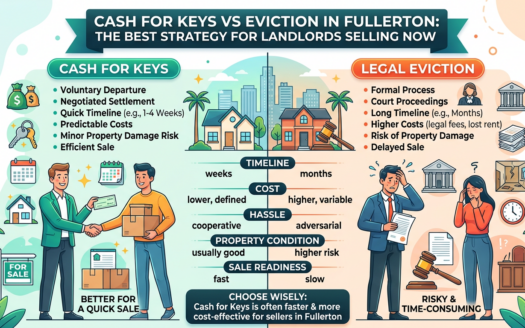
The voluntary move-out arrangement, commonly called “cash for keys”, sits between keeping tenants in place through closing and pursuing formal eviction. You’re offering your tenant a lump-sum payment in exchange for vacating by a specific date, creating a clean transaction that benefits both parties when structured correctly. The approach works because it recognizes that your timeline urgency and the tenant’s relocation burden both have quantifiable financial value that can be negotiated.
Determining the appropriate cash-for-keys amount requires balancing several factors. Consider your tenant’s length of occupancy, their payment history and property care, the local moving and rental market conditions, your timeline urgency, and what a formal eviction would cost if you pursued that path instead. A tenant who has occupied your Fullerton property for five years, maintained excellent payment consistency, and kept the property in good condition deserves more generous compensation than someone with six months’ occupancy and spotty rent history.
Never pay the full cash-for-keys amount before your tenant vacates. Structure payment for after move-out verification or use a split arrangement: partial payment upon agreement execution, balance after confirmed vacancy and property inspection.
Market conditions in Fullerton influence what constitutes attractive compensation. With median rents around $2,194 and typical security deposits and first month’s rent totaling approximately $4,388, your tenant faces immediate upfront costs of that magnitude to secure replacement housing.7 Add moving expenses averaging $1,200 to $2,500 for local moves, utility connection fees, and the time cost of apartment searching, and you’re looking at genuine relocation hardship in the $7,000 to $10,000 range for a household transitioning to comparable housing.
New 2026 California rental laws you must comply with before closing
January 1, 2026, marked a significant inflection point for California landlords, with multiple new statutes taking effect that materially affect sales of tenant-occupied properties. These aren’t minor technical updates. They create immediate compliance obligations that can affect your closing timeline and expose you to legal claims if you transfer a property that doesn’t meet current standards.
AB 628 requires that both a working stove and a refrigerator be installed in habitable rental units. If either appliance is recalled, you must replace or repair it within thirty days of notice.2 This requirement creates a pre-closing compliance task: audit the operability of your refrigerator and stove, verify they meet current safety standards without active recalls, and budget for replacement if either appliance fails these tests. A property transferred with non-compliant appliances creates immediate liability for the new owner and potentially for you if the deficiency existed before closing and wasn’t properly disclosed.
The practical implication for your Fullerton property sale: Schedule an appliance functionality inspection before listing. If your twenty-year-old refrigerator is limping along but technically operational, recognize that it may fail during the buyer’s inspection period or shortly after closing. Replacing marginal appliances before listing prevents deal complications and positions your property as well-maintained to prospective buyers evaluating its condition.
Budget $800 to $1,500 for a new refrigerator and $600 to $1,200 for a new stove if your current appliances don’t meet 2026 habitability standards. These costs are substantially less than post-closing disputes with buyers over appliance deficiencies.
Marketing strategies that attract the right buyer pool
Fullerton Market Snapshot
Your property’s tenant-occupied status isn’t a liability to hide. It’s a feature to highlight for the buyer segment that values it. The marketing approach should explicitly position the occupied property as a turnkey investment opportunity with immediate cash flow, proven tenant reliability, and eliminated vacancy risk. Generic “investment property” language doesn’t accomplish this. You need specific data points that allow investor buyers to underwrite your property’s rental income potential from day one.
Create comprehensive tenant documentation that becomes part of your marketing package. Include the current lease term and expiration date, monthly rent amount, and payment history showing consistency, length of occupancy demonstrating stability, property maintenance cooperation, and any tenant-reported issues, and how the current rent compares to Fullerton market rates for similar properties. An investor reviewing this documentation can immediately assess whether your $2,200 monthly rent aligns with the market median of $2,194 and whether your tenant’s five-year occupancy suggests retention likelihood.7
Highlight Fullerton’s rental market fundamentals in your listing narrative. The 51.5 percent homeownership rate means nearly half of all households rent, creating deep tenant demand that supports stable occupancy.7 The presence of three higher education institutions generates consistent rental demand from students and young professionals who value walkability. Your property’s Walk Score of 97 positions it perfectly for this demographic. These fundamentals reassure investors that even if your current tenant eventually moves, replacement tenants will be readily available in a market with strong rental demand drivers.
Key Takeaways
- Legal Reality: Selling your property is not a valid just cause for eviction under California’s Tenant Protection Act. You must work with tenants or negotiate voluntary move-outs.2
- Investor Appeal: Properties with reliable tenants paying a $2,194 median rent offer immediate cash flow, which many buyers prefer to vacant properties that require a tenant search.7
- 2026 Compliance: New appliance habitability standards require that working stoves and refrigerators be included. Audit before listing to prevent closing complications.2
- Showing Protocol: You must provide twenty-four hours’ written notice before entries and ten days’ notice for open houses, with the tenant’s right to propose alternatives
- Cash-for-Keys Strategy: Voluntary relocation payments of $7,000 to $15,000 often achieve faster vacancy than attempted eviction while avoiding legal exposure.
The Bottom Line
California’s tenant protection framework and new 2026 legislation have eliminated most eviction pathways for property sales while simultaneously creating opportunities to market your Fullerton rental property to investor buyers who value occupied properties. The median sale price of $952,500, combined with strong rental demand from nearly half of all households, creates a robust market for tenant-occupied properties when you approach the transaction with clear legal compliance, transparent buyer communication, and strategic tenant cooperation. Whether you pursue a cash-for-keys negotiation, market to investors seeking immediate rental income, or structure a compliant showing schedule that respects tenant privacy, you have multiple legal alternatives to eviction that can achieve your sale objectives while protecting you from costly litigation exposure.
Ready to Sell Your Tenant-Occupied Fullerton Property?
With 190 North Orange County transactions and deep expertise in tenant-occupied property sales, we know exactly how California’s legal framework impacts your timeline and sale price. Let’s create a customized strategy that maximizes your proceeds while respecting tenant rights and avoiding legal exposure.
📞 Call (714) 746-6355
🌐 Visit go2wendy.com
Serving Fullerton and North Orange County since 2012 | DRE #01898824
Frequently Asked Questions About Eviction Guide Fullerton
How does AB 628’s new appliance requirement affect my 2026 tenant-occupied property sale?
AB 628 requires that working stoves and refrigerators be used as habitability standards starting January 1, 2026. Before closing, you must verify that both appliances function properly or disclose non-compliance to buyers. If either appliance is recalled, you’re responsible for replacement within thirty days. Budget for potential appliance upgrades before listing, as buyers may demand compliance repairs or negotiate price reductions for properties with outdated or malfunctioning units, particularly affecting older Fullerton rental homes.
What cash-for-keys amount is reasonable for a Fullerton tenant who’s occupied my property for three years?
Consider offering $3,000 to $6,000 to established tenants, based on Fullerton’s median rent of $2,194 and typical moving costs, including first month’s rent, security deposit, and moving expenses. Long-term tenants warrant higher compensation, particularly if they’ve maintained excellent payment history. Compare this to potential carrying costs: with a median days-on-market of 45 days, a negotiated early move-out might enable faster sales of vacant properties to owner-occupant buyers willing to pay premium prices.
Can investor buyers actually pay more for my Fullerton rental with tenants in place?
Yes, particularly in Fullerton, where the homeownership rate is 51.5%, indicating substantial rental demand. Investors seeking immediate cash flow avoid vacancy costs and tenant search expenses. A property generating $2,200 monthly rent provides immediate returns, eliminating the typical thirty-to-sixty-day turnover period. With 27.3% of Fullerton homes selling above list price, quality tenant-occupied properties that attract multiple investor offers can command competitive pricing, especially when marketed to the right buyer pool.
How does AB 1482’s mid-2026 expiration affect my property’s investor appeal?
AB 1482’s current five-percent-plus-inflation annual rent cap expires mid-2026, creating uncertainty about future rent control rules. Savvy investors may prefer purchasing before any potentially stricter replacement legislation takes effect. Properties sold early in 2026 offer buyers clarity under existing caps, while late-2026 transactions face regulatory uncertainty. This timing consideration affects how you position your tenant-occupied property’s income potential, particularly for properties currently rented below Fullerton’s $2,194 median where upside exists.

Wendy Rawley
REALTOR® | DRE #01898824
Wendy Rawley and The Wendy Rawley Team at Circa Properties have helped hundreds of North Orange County families navigate their real estate journeys. With deep local expertise in Fullerton and the surrounding communities, Wendy provides personalized guidance for every client.
📍 Office: Circa Properties, 18206 Imperial Hwy, Ste 101, Yorba Linda, CA 92886
📞 Phone: (714) 746-6355
🌐 Website: go2wendy.com
Serving: Yorba Linda, Placentia, Brea, Fullerton, Anaheim Hills, Anaheim, La Habra, Orange
Market data in this article is sourced from Redfin and is updated on the third Friday of each month. Redfin releases monthly housing data on that date, and we refresh our statistics accordingly. The latest update was on 2026-02-20.
Sources & Data
1 Redfin – Fullerton Housing Market Data
URL: https://www.redfin.com/city/6418/CA/Fullerton/housing-market
Current Fullerton real estate market statistics including median sale prices, days on market, and inventory levels as of 2025-12-31.
2 California Legislative Information – Tenant Protection Act of 2019 (AB 1482)
URL: https://leginfo.legislature.ca.gov/faces/billTextClient.xhtml?bill_id=201920200AB1482
Full text of Assembly Bill 1482 establishing statewide just cause eviction requirements and rent increase caps that govern tenant-occupied property sales.
3 California Civil Code Section 1946.1 – Notice Requirements
URL: https://leginfo.legislature.ca.gov/faces/codes_displaySection.xhtml?lawCode=CIV§ionNum=1946.1
Statutory requirements for notice periods based on tenancy duration in California rental properties.
4 California Civil Code Section 1954 – Landlord Entry Rights
URL: https://leginfo.legislature.ca.gov/faces/codes_displaySection.xhtml?lawCode=CIV§ionNum=1954
Statutory requirements for landlord entry into occupied rental units including notice requirements for property showings.
5 California Civil Code Section 1950.5 – Security Deposit Regulations
URL: https://leginfo.legislature.ca.gov/faces/codes_displaySection.xhtml?lawCode=CIV§ionNum=1950.5
State law governing security deposit handling, transfer requirements between owners, and return procedures.
6 Zillow Research – Rental Market Trends
URL: https://www.zillow.com/research
Analysis of rental market conditions and investor trends affecting tenant-occupied property sales in California markets.
7 U.S. Census Bureau – Fullerton City Demographics
URL: https://www.census.gov
Demographic and housing occupancy data for Fullerton including renter-occupied housing statistics.
Important Disclaimer
This article provides general information about real estate in Fullerton and North Orange County. Real estate markets change constantly, and individual circumstances vary significantly. This content does not constitute financial, tax, legal, or mortgage lending advice. Mortgage rates, terms, and qualification criteria vary by lender and change frequently. Consult qualified professionals, including a licensed mortgage loan originator, CPA, and real estate attorney, before making real estate or financing decisions. Wendy Rawley is a licensed California real estate agent (DRE #01898824) and provides this information for educational purposes only.
Equal Housing Opportunity. We are committed to complying with all federal, state, and local fair housing laws.