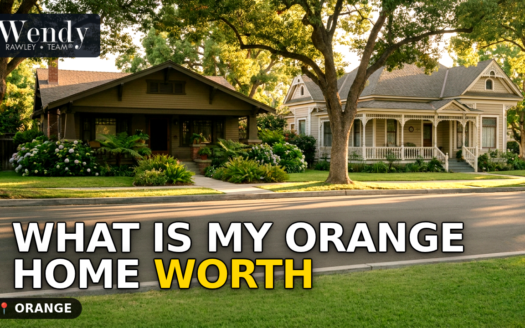

Orange Move-Up Buyers in 2026: How the Conforming Loan Limit Shapes Your Bridge-vs-Sell-First Decision
Orange Move-Up Buyers in 2026: How the $1,249,125 Conforming Loan Limit Shapes Your Bridge-vs-Sell-First Decision
When you trade up in Orange, your next loan can cross the $1,249,125 conforming line into costlier jumbo territory, and how much equity you free up first, by selling first or bridging, is what decides which side you land on.
The Wendy Rawley Team · First Team Real Estate · North Orange County, CA
Quick Answer
The Orange move-up conforming loan limit decision comes down to one fact: conforming versus jumbo is set by your loan amount, not the purchase price, so at Orange’s $1,249,000 median a normal down payment keeps most buyers comfortably conforming. The line only bites when you trade up: above roughly $1.56M with 20% down, your next loan crosses the $1,249,125 limit3 into jumbo, where lenders typically want a bigger down payment, more reserves, and tighter debt-to-income. Whether you stay under that line usually comes down to your down payment, and your down payment depends on how much equity you free up before you buy. Selling first converts equity to cash (bigger down, easier to stay conforming); a bridge loan or HELOC lets you buy first but can leave less to put down. So in Orange the sell-first-versus-bridge question and the conforming-versus-jumbo question are really one decision5. Confirm your exact loan amount and conforming or jumbo status with a licensed mortgage loan originator before you write anything.
What is your Orange home actually worth?
Get a free, instant estimate of your Orange home value and equity. No obligation, just a real starting point before you decide anything.
Get My Free Home Value ReportOrange move-up at a glance
| Median sale price | $1,249,000 |
| Days on market | 33 days |
| 30-year fixed rate | 6.49% |
| OC conforming loan limit | $1,249,125 |
Redfin market figures reflect the most recent monthly reporting period available at publication (see Sources & Data for the data center and access date). Payment and tax estimates below are illustrative; confirm yours with a lender.
The hard part of moving up in Orange usually isn’t finding the next house. It’s the gap between selling and buying, and in Orange there’s a second, local wrinkle most move-up guides skip. Orange’s $1,249,000 median1 isn’t where the jumbo line sits, that’s set by your loan amount, not your price, but it does mean a lot of move-up buyers here are trading up into the $1.5M-plus range, which is exactly where the county’s $1,249,125 conforming limit3 starts to matter.
Here’s why it ties to your timing decision. How you handle the gap, borrowing against your equity to buy first, or selling first and buying with proceeds in hand, changes how much cash you can put down, and your down payment is often what decides whether that higher next loan stays conforming or tips into jumbo. So in Orange the question isn’t only “bridge, HELOC, or contingency?” For a trade-up buyer it’s also “which path keeps my next loan on the right side of $1,249,125?” The rest of this guide answers both together.
Orange Market Snapshot, What Move-Up Buyers Need to Know
Local conditions set the tone for how aggressively you can move. With 2.3 months of supply and homes selling in a median of 33 days1, well-positioned Orange sellers still have meaningful leverage, especially when a home is priced and prepared correctly. The current Redfin median sale price in Orange is $1,249,0001, a figure that matters twice here: it sets your likely equity, and it anchors the Orange move-up conforming loan limit question, the $1,249,125 conforming ceiling3 conversation that shapes a trade-up mortgage. The 12-month rolling price trend is up roughly 0.6%1. Past performance does not guarantee future results.
🏠 Orange Equity Context
45.7% of Orange homes sold above their list price in the most recent period1. In a market where nearly half of recent sales cleared above asking, a contingent offer can be harder to get accepted.
When a meaningful share of homes clear above their asking price, a contingent offer reads weaker to a seller who has choices. A seller comparing two similar bids will usually take the one with fewer ways to fall apart. As of June 25, 2026, the 30-year fixed rate is 6.49% and the 15-year fixed is 5.84%2; rates change weekly. That backdrop points you toward three practical paths, but in Orange one local number decides which of them actually fits.
The Orange Move-Up Conforming Loan Limit: Your Hidden $1,249,125 Lever
Here is what sets Orange apart from a generic move-up market. Whether a mortgage is conforming or jumbo depends on the loan amount, not the purchase price. At Orange’s $1,249,000 median1, a 20%-down purchase finances around $999,000, comfortably under the county’s 2026 conforming limit of $1,249,1253. The line only starts to bite when you trade up: with 20% down, your next loan stays conforming up to about a $1.56M purchase, and above that you are usually in jumbo unless you bring more cash down. Jumbo financing typically means a larger down payment, more reserves, tighter debt-to-income, and rate behavior that moves on its own schedule. Jumbo is not automatically worse, though; it simply carries different approval standards, reserve requirements, pricing, and documentation, so model it before you assume which path wins.
Because so many Orange move-up buyers are trading up into that range, the down payment you can muster, which depends on whether you have sold yet, often decides which side of the line you land on:
| Next purchase price | Down payment | Loan amount | Conforming or jumbo? |
|---|---|---|---|
| $1,400,000 | 20% ($280,000) | $1,120,000 | Conforming |
| $1,561,000 | 20% ($312,200) | $1,248,800 | Conforming (right at the limit) |
| $1,700,000 | 20% ($340,000) | $1,360,000 | Jumbo |
| $1,700,000 | ~27% ($459,000) | $1,241,000 | Conforming |
| $2,000,000 | 20% ($400,000) | $1,600,000 | Jumbo |
Illustrative only. Notice the $1,700,000 row: the same home is conforming or jumbo depending only on how much you put down, which is exactly the lever your sale timing controls. Loan programs, rates, reserves, DTI treatment, HELOC availability, and jumbo-versus-conforming pricing vary by lender and borrower, so confirm your scenario with a licensed mortgage loan originator.
That is why, on a trade-up, the three move-up paths are really a question about your down payment, not just your timeline:
- Selling first converts your equity to cash before you buy, so you can put more down, the cleanest way to keep a higher next loan under $1,249,125 and conforming.
- A bridge loan lets you buy before you sell, but it often unlocks less usable cash than a completed sale and adds debt your lender weighs in DTI and reserves, so on a trade-up it can leave you bringing less to the table, closer to the jumbo line.
- A HELOC taps your current equity for the down payment, which can help you stay conforming, yet it adds a second payment your lender counts in DTI, and many lenders will not open one once the home is listed.
So in Orange, decide the financing sequence and the conforming question together with your lender, not separately. Here is how the three paths compare.
How Each Path Affects Your Down Payment and Loan Type
You have three ways to handle the gap, and each one moves the risk to a different place. A bridge loan or HELOC lets you buy before you sell, putting the financing risk on you. A home-sale contingency keeps your money safe but puts deal risk in front of the seller. Selling first removes financing pressure but can leave you renting or racing to find your next home. The table breaks down how each one trades off.
| Consideration | Bridge Loan | HELOC | Sell First |
|---|---|---|---|
| Typical use case | Fund next down payment before current home sells | Draw equity as a flexible line before listing | Close sale first, then buy with proceeds in hand |
| DTI treatment of current mortgage | May still count; confirm with lender | Adds a payment; confirm DTI impact | Current mortgage gone before next loan |
| Carry-cost risk if slow to sell | Higher, paying on two properties | Higher, line plus existing mortgage | Lowest, no overlap |
| Best fit | DTI headroom + need a non-contingent offer | Set up early; want flexible equity access | Tight DTI or proceeds-dependent down payment |
- Bridge loan, when you have DTI headroom and need a clean, non-contingent offer to compete.
- HELOC, when you can set it up before listing and want flexible access to your equity.
- Sell first, when your DTI is tight or your next down payment depends on sale proceeds; you trade overlap risk for a temporary place to live.
Carry-Cost Risk During the Overlap
Before you commit to buying first, run the overlap month on paper. Use the estimated payment for your target purchase price, plus tax, insurance, HOA, and any bridge or HELOC payment, and see what carrying both homes for a few weeks actually costs you.
- Principal, interest, taxes, and insurance on both homes during the overlap
- HOA dues on both properties, common across many Orange communities
- Two homeowners-insurance policies running simultaneously
- Your bridge lender’s deadline for selling the current home
- Any appraisal or financing contingency on your purchase loan
Model these with your lender for your actual scenario. Overlap costs vary widely by loan structure, property values, and HOA situation, so a personalized estimate is the only reliable figure.
Two quick tests before you choose a path
Educational estimates, not a loan approval. Confirm every figure with your lender.
1. The overlap test: can you carry both?
Add the monthly carry on your current home (mortgage, tax, insurance, and any HOA), the payment on your next home (the figure shown above, plus tax and insurance), and the monthly cost of any bridge or HELOC draw. Multiply that monthly total by the one, two, or three months you might realistically own both homes, then compare it to your cash reserves. If it stresses your budget, selling first or a contingency may beat a bridge.
2. The cash-to-close test: can you unlock enough?
Estimate your net sale proceeds (sale price, minus loan payoff, minus selling costs), then check that they cover your next down payment, closing costs, and the reserves a lender wants left over, while your debt-to-income still qualifies with both loans counted. A bridge or HELOC bridges timing, not a shortfall in equity or income.
Which move-up path fits your priority?
A starting framework, not a recommendation. Your lender confirms what you actually qualify for.
| If your priority is | A common path | The main risk to weigh |
|---|---|---|
| Buying before you sell | Bridge loan | Carrying two payments longer than planned, plus bridge fees |
| Keeping your low first mortgage | HELOC | A variable-rate second payment; many lenders may not open a HELOC once the home is listed |
| Avoiding temporary financing | Sell first, with a rent-back | Lining up timing, or temporary housing if a rent-back is not available |
| Making the cleanest offer | Sell first or non-contingent | A home-sale contingency reads weaker in a competitive segment |
What Your Next Orange Home Will Cost to Own
It helps to see the next home as a steady monthly number, not just a sale price. As an illustration, financing the $1,249,000 median1 with 20% down at the 6.49% 30-year rate2 puts principal and interest near $6,309 a month on the next home, before property tax, insurance, and any HOA; your equity, loan size, and actual terms move the number, so confirm it with a lender.
Your tax base resets too, and that often surprises move-up buyers. When you buy your next Orange home, a change in ownership generally triggers a reassessment, so Prop 13 sets a new base-year value at your purchase price4; at the roughly 1% base rate plus local voter-approved bonds and any Mello-Roos6, a home around the $1,249,000 median1 runs roughly $12,490 a year, so budget the new tax base into the move. Newer pockets near Santiago Hills and Serrano Heights can carry Mello-Roos that older streets around El Modena typically don’t, so the line item varies by parcel.
Will You Owe Tax When You Sell Your Current Home?
Selling the home you’ve owned a long time can create a taxable gain, and that’s worth modeling before you list. When you sell your current home, the federal home-sale exclusion may let you exclude up to $250,000 of gain if you file singly, or $500,000 if you are married filing jointly, when you meet the IRS ownership, use, and look-back rules7; a long-held home with a large gain can still owe tax above those limits, so confirm your number with a CPA. We see this most with owners who bought decades ago on the larger lots near Orange Park Acres, where appreciation may have pushed the gain past the exclusion. Treat this as general information and route the actual math to your CPA.
How Orange’s Conditions Shape the Decision
The conditions in the snapshot above push the decision in a clear direction. With supply tight and homes moving in roughly a month, a clean non-contingent offer earns its keep, because a seller weighing two bids tends to favor the one with fewer contingencies. The softer side is the price trend: a modest year-over-year move lowers the pressure to overbid, so you can hold your number while still presenting a strong offer. Match your posture to both halves of that picture, and weigh the Orange move-up conforming loan limit against your likely down payment before you commit.
Your Next Steps for Moving Up in Orange
- Get pre-qualified on both products: ask a licensed mortgage loan originator to model a bridge loan and a HELOC side by side, including how your current mortgage affects DTI on each.
- Estimate your current home’s likely sale window: compare your home against recent comps in your submarket to gauge whether the 33 days median applies to you.
- Budget the next home, not just the move: the monthly payment, the reset property-tax base, the Orange move-up conforming loan limit on your next loan, and any capital-gains tax on your sale are separate numbers worth modeling before you write an offer.
- Decide your offer posture: match your financing path to the buy-side market, non-contingent where homes move fast, contingent where a listing has time and you need to protect your equity. Reach out and we’ll map it to your numbers.
Frequently Asked Questions for Move-Up Sellers in Orange
What should I ask my lender before choosing a bridge loan or HELOC?
Ask how your current mortgage payment counts in DTI under each path, since a bridge loan, a HELOC, and a contingent purchase treat that obligation differently. Ask whether your current home must be listed or already under contract to qualify. Ask the maximum combined loan-to-value they’ll allow, and pin down the fees plus the repayment deadline on any bridge financing so you know exactly when the balance comes due.
How much inventory is on the Orange market, and what does that mean for my timing?
Orange currently has 413 active listings, with 234 homes sold and 251 pending sales in the recent period1. With pending sales running close to active inventory, well-prepared listings tend to find buyers without sitting long. For a move-up seller, that supports timing your sale and purchase tightly, though your specific street and price band can still move faster or slower than the citywide read.
Does Orange’s median price mean my next purchase needs jumbo financing?
Price and loan size aren’t the same thing, so don’t assume the median forces you into jumbo. Orange’s median sale price of $1,249,0001 sits below the Orange County conforming loan limit of $1,249,1253, but jumbo status depends on your loan amount, not the purchase price. With enough down payment, a higher-priced home can still finance within conforming limits, so confirm your borrowing structure with a lender.
Will my property taxes change when I move up in Orange?
Buying generally resets your assessed value to the new purchase price, so your tax bill on the next home will likely differ from what the prior owner paid. After closing, expect a separate supplemental tax bill covering the mid-year difference between the old and new assessments, and set money aside for it because it can arrive months later. Confirm the parcel rate and any Mello-Roos with the county assessor for your exact address.
Will I owe capital gains tax when I sell to move up?
When you sell your current home, the federal home-sale exclusion may let you exclude up to $250,000 of gain if you file singly, or $500,000 if you are married filing jointly, when you meet the IRS ownership, use, and look-back rules7; a long-held home with a large gain can still owe tax above those limits, so confirm your number with a CPA. This is general information, not tax advice, so let your CPA run your actual basis and holding period.
Moving Up in Orange and Not Sure Whether to Buy Before You Sell?
Wendy Rawley can help you compare the real-estate timing, likely sale proceeds, offer-strength trade-offs, and next-purchase sequence, while your licensed mortgage loan originator models the bridge loan, HELOC, DTI, conforming-limit, and payment scenarios.
📞 Call (714) 746-6355🌐 Visit go2wendy.comServing Orange and North Orange County since 2011 | DRE #01898824

Wendy Rawley
REALTOR® | DRE #01898824
Wendy Rawley and The Wendy Rawley Team help move-up clients coordinate their sale, net proceeds, timing, and next-purchase strategy across North Orange County. With deep local expertise in Orange and surrounding communities, Wendy provides personalized guidance for every client.
Across North Orange County, the team has represented sellers in 114 transactions and buyers in 76, including 14 here in Orange8.
Sources & Data
1 Redfin, Orange Housing Market Data
Redfin Data Center, published, downloadable market metrics (median sale price, inventory, days on market, months of supply, and year-over-year trends) by region, including Orange.
2 Freddie Mac, Primary Mortgage Market Survey (via FRED)
Weekly average 30-year and 15-year fixed mortgage rates.
3 FHFA, Conforming Loan Limit Values
Orange County 2026 high-cost-area one-unit conforming loan limit: $1,249,125.
4 California State Board of Equalization, Proposition 13 and Change in Ownership
Under Proposition 13, a change in ownership generally triggers a reassessment of the property to its current market value, which becomes the new base-year value (taxed at the roughly 1% base rate plus local voter-approved charges). Exclusions may apply, so confirm the parcel-specific treatment with the county assessor.
5 Consumer Financial Protection Bureau, What is a bridge loan?
Federal consumer-protection explainer defining bridge loans and their risks.
6 California Prop 13 / Orange County property tax
California limits the base property-tax rate to 1% of assessed value (Prop 13), plus local voter-approved bonds and any Mello-Roos. Confirm the exact tax rate, any Mello-Roos, and special assessments for a specific parcel.
7 IRS Publication 523, Selling Your Home
Federal rules for the home-sale capital-gains exclusion (up to $250,000 of gain for a single filer, $500,000 for a married couple filing jointly) and the ownership/use tests. Eligibility depends on ownership history, use, filing status, prior exclusions, and other facts, so confirm with a CPA.
8 California Regional Multiple Listing Service (CRMLS)
The Wendy Rawley Team’s closed-transaction counts (2012-2025) are drawn from CRMLS sold records, the regional multiple listing service for Southern California.
Disclaimer: This article is for informational purposes only and does not constitute legal, tax, financial, or mortgage-lending advice. Real estate commissions are negotiable and vary by brokerage. Mortgage rates, terms, and qualification criteria vary by lender and change frequently. Consult qualified professionals, including a CPA and a licensed mortgage loan originator, regarding your specific situation. The Wendy Rawley Team | First Team Real Estate | DRE #01898824.
Equal Housing Opportunity.