

ADU Rules in Yorba Linda (2025 Update): Setbacks, Parking & Fast-Track Permits

ADU Rules in Yorba Linda (2025 Update): Setbacks, Parking & Fast-Track Permits
Your Complete Guide to Building an Accessory Dwelling Unit in Orange County’s Hidden Gem
Everything you need to know about setback requirements, parking regulations, and the 60-day fast-track approval process for ADUs in Yorba Linda, California.
By Wendy Rawley, REALTOR® | DRE #01898824
Published: October 21, 2025 | Updated for Current Market
💡 Bottom Line Up Front: Yorba Linda now allows most compliant ADUs through a streamlined 60-day ministerial approval process with 4-foot side and rear setbacks1. You can build up to 1,000 square feet (or 1,200 square feet with Design Review on larger lots)2, and you’re no longer required to live on the property thanks to AB 9763. Impact fees are waived for ADUs under 750 square feet4, making this one of the most ADU-friendly cities in Orange County.
Look, I’ve been working with Yorba Linda homeowners for over 15 years, and I’ve never seen this much interest in ADUs. Just last month, I had three different clients call me asking about building granny flats in their backyards on Hidden Hills Road and Yorba Linda Boulevard. The rules have changed dramatically since 2020, and honestly, they’re way more homeowner-friendly than most people realize.
Here’s the thing that surprises most of my clients: building an ADU in Yorba Linda is actually pretty straightforward now. Gone are the days when you needed to go through months of Planning Commission hearings and jump through endless hoops. The state basically forced cities to streamline the process, and while some cities fought it tooth and nail, Yorba Linda has actually embraced the changes pretty well.
I’m going to walk you through everything you need to know about ADU regulations in Yorba Linda as of 2025. We’ll cover the specific setback requirements (because that’s usually the first stumbling block), parking rules (which have more exemptions than you’d think), and this fast-track ministerial approval process that can get your permits in 60 days or less. I’ve helped homeowners navigate this process in neighborhoods from Fairmont to Travis Ranch, so I know where the tricky parts are.
What really excites me about ADUs is the flexibility they give homeowners. Whether you’re looking to house aging parents, create a home office that’s actually separate from your house (trust me, after working from home during 2020, I get it), or generate some rental income to offset your mortgage, an ADU can be a game changer. In Yorba Linda’s 92886 and 92887 zip codes, where property values have climbed to a median of around $1.4 million5, having that extra income stream or housing flexibility is huge.
🏠 What Types of ADUs Are Actually Allowed in Yorba Linda?
Let me break this down in plain English because the legal terminology can make your eyes glaze over. Yorba Linda allows three main types of accessory dwelling units, and each one has slightly different rules.
First, you’ve got your standard detached ADU. This is what most people picture when they think about a granny flat. It’s a completely separate structure in your backyard, typically between 400 and 1,000 square feet. I helped a client on Via del Agua build a beautiful 850-square-foot detached unit last year, and it appraised for an additional $180,000 in value. That’s not a typo. These things seriously boost your property value.
Then there are attached ADUs, which share at least one wall with your primary residence. Think of it like adding a mother-in-law suite onto the side of your house. The rules for attached ADUs are actually a bit more generous (you can go up to 50% of your primary dwelling’s square footage)6, but most people prefer detached units for the privacy factor.
The third option is a Junior ADU, or JADU. These are smaller units (500 square feet or less) that must be contained entirely within your existing house or an attached garage7. Here’s the catch with JADUs: you still have to live on the property, either in the main house or the JADU itself. Regular ADUs? Not anymore. I’ll get into that later, but it’s a big deal.
You can also convert existing structures. Got a garage you’re not using? Perfect ADU candidate. That bonus room over the garage that’s currently storing Christmas decorations from 2003? Could be an ADU. Honestly, garage conversions are some of my favorite ADU projects because you’re working with existing foundation and walls, which can save you $50,000 to $80,000 in construction costs compared to building from scratch.
📍 Quick Reality Check on What You Can Build:
- Single-family properties: You can build ONE detached or attached ADU, plus ONE JADU if you’re owner-occupied8
- State law guarantees you can build at least 800 square feet at 16 feet tall, regardless of local zoning9
- Multi-family properties have different rules (generally one ADU per existing unit, capped at certain limits)
- Your property must have an existing or proposed primary dwelling to be eligible
Ready to Explore Building an ADU on Your Yorba Linda Property?
I’ll help you understand exactly what’s possible on your specific lot, navigate the permit process, and connect you with trusted ADU builders I’ve worked with for years.
📞 Call or Text: (714) 746-6355
✉️ Email: wendy@go2wendy.com
Free consultation | No pressure | Just honest advice from a local expert
📏 Setback Requirements: The Numbers That Actually Matter
Okay, this is where things get specific, and honestly, this is where I see the most confusion from homeowners. Setbacks are basically the required distance between your ADU and your property lines. Get these wrong, and your permit gets denied. Simple as that.
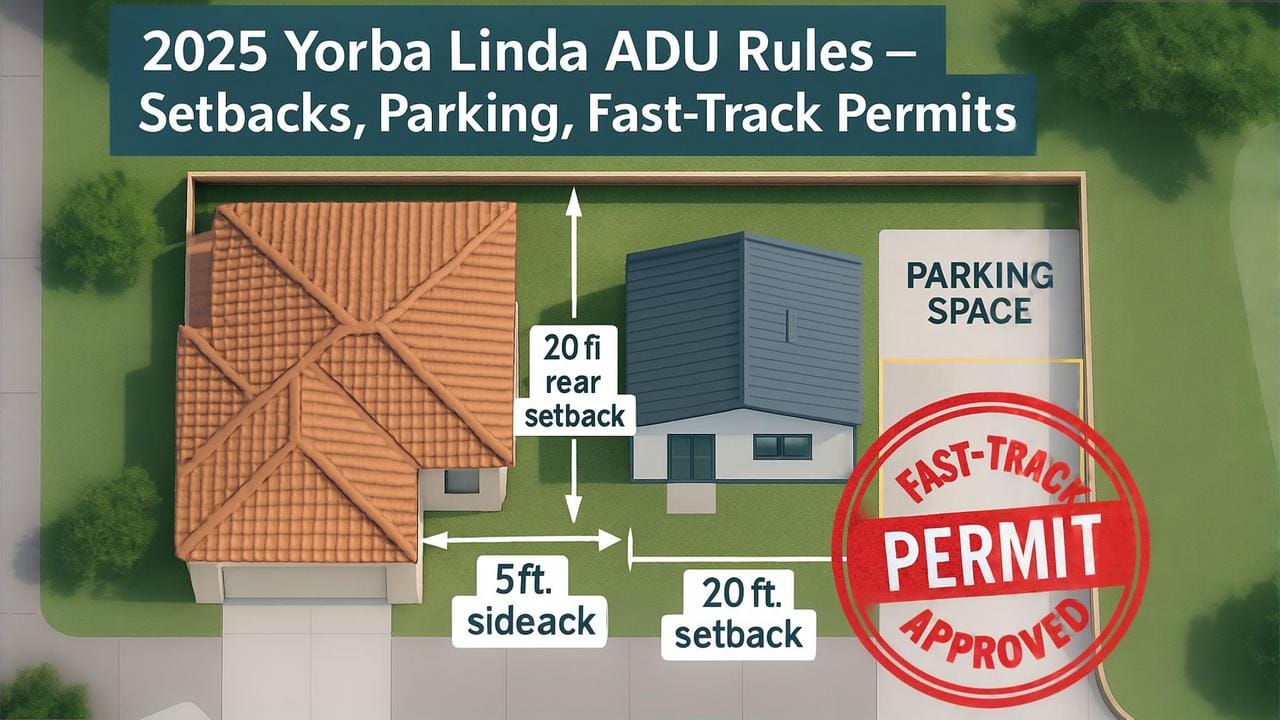
For detached ADUs in Yorba Linda, you need a minimum of 4 feet from your side and rear property lines1. That’s it. Four feet. I remember when it used to be 10 feet or more, so this is actually pretty generous. But here’s what catches people: that’s just for the sides and back. Your front setback depends on your specific zoning district, and it’s usually going to be more like 20 to 30 feet from the front property line1.
Let me give you a real-world example. Last spring, I worked with a couple on Rose Drive who wanted to build a 700-square-foot ADU in their backyard. Their lot was about 10,000 square feet (pretty typical for that neighborhood), and we had to carefully position the ADU to maintain that 4-foot clearance from the side and rear property lines while also staying well back from the street. We ended up placing it in the back corner of their lot, about 80 feet from the front property line, and it worked beautifully.
Here’s something that surprises a lot of people: if you’re converting an existing structure (like that garage I mentioned earlier), you’re exempt from setback requirements2. So if your garage is already only 3 feet from the property line, you can still convert it to an ADU. The state basically said, “Look, the structure is already there, don’t make people tear it down and rebuild it just to meet setback rules.”
Front setbacks are where things get a bit more complicated because they vary by zone. Most residential areas in Yorba Linda have front setbacks of 20 to 30 feet, but some older neighborhoods or areas with specific overlays might have different requirements. This is where calling the Planning Department at (714) 961-7170 before you finalize your plans is actually worth the time. Trust me, better to know upfront than to have your plans rejected after you’ve already paid your architect.
💡 Pro Tip: If your lot is larger than 15,000 square feet, you might be able to build an ADU larger than 1,000 square feet (up to 1,200 square feet) through the Design Review process1. It takes a bit longer, but for larger properties in areas like Bryant Ranch or Serrano Heights, this can be worth it. I’ve seen it approved plenty of times when the design fits the neighborhood character.
🚗 Parking Requirements (and the Exemptions You Need to Know About)
Here’s where California really helped homeowners out. The parking requirements for ADUs are way more relaxed than they used to be, and there are so many exemptions that honestly, most ADU projects I work on don’t actually need to add any parking at all.
The basic rule is simple: you need one parking space for your ADU2. Sounds straightforward, right? But then come the exemptions, and this is where it gets interesting.
You don’t need to provide parking if your ADU is located within half a mile walking distance of public transit2. In Yorba Linda, this mainly applies to areas near the Metrolink station or along major bus routes on Yorba Linda Boulevard and Imperial Highway. I worked with a client on Casa Loma Drive whose property was just under half a mile from the Metrolink, and we measured it out with Google Maps to make sure we qualified for the exemption. We did, and it saved them from having to reconfigure their driveway.
You also get a parking exemption if your ADU is converted from existing space, like a garage, bedroom, or storage room2. This is huge because a lot of ADUs are garage conversions. The state basically said, “Look, if you’re demolishing a garage to create an ADU, we’re not going to make you replace that garage parking.” Makes sense when you think about it.
Here’s another exemption that helps: if on-street parking permits are required in your area but you wouldn’t be eligible for one, you don’t need to provide ADU parking2. This doesn’t apply to most of Yorba Linda (we don’t really have permit parking here), but it’s good to know.
And this one’s interesting: if there’s a car-share vehicle located within one block of your ADU, you’re exempt from parking requirements2. I haven’t seen this used much in Yorba Linda yet (we’re not exactly a Zipcar hotspot), but as car-sharing services expand, this could become more relevant.
What really matters is the tandem parking rule. Even if you do need to provide parking, it can be tandem (one space behind another) and doesn’t need to be covered2. So you can literally just pour a concrete pad next to your driveway, and that counts. I’ve seen this done on countless properties along Bastanchury Road and throughout the Travis Ranch area.
💪 Common Parking Scenarios in Yorba Linda:
- Garage conversion: No parking required (you’re demolishing the garage, so the city doesn’t require replacement)
- Backyard detached ADU: One space needed, but can be uncovered tandem parking
- Within 0.5 miles of transit: No parking required at all
- Junior ADU (JADU): No parking required12
📬 Get Yorba Linda Real Estate Insights Delivered Monthly
Market updates, ADU tips, new listings, and local insights straight to your inbox. No spam, just valuable information.
Join 500+ Yorba Linda homeowners who get the inside scoop
⚡ Fast-Track Permits: The 60-Day Ministerial Approval Process
This is probably the biggest game-changer in ADU development. Used to be, getting an ADU approved in Yorba Linda could take six months or more, and you’d have to go through Planning Commission hearings where neighbors could show up and object. Not anymore.
California law now requires cities to ministerially approve compliant ADU applications within 60 days3. “Ministerial” is a fancy word that basically means it’s an administrative approval by staff, not a discretionary approval by elected officials. If your ADU meets all the objective standards (setbacks, height limits, size limits), the city has to approve it. They don’t get to say no just because they don’t like how it looks or because a neighbor complains.
Let me tell you about a client I worked with on Woodcreek Road. We submitted their ADU permit application in March of this year, and they had their approved permits in hand by early May. Fifty-eight days. The building department was actually pretty helpful throughout the process, pointing out a couple minor issues with the electrical plans that needed fixing, but overall it was smooth sailing.
Here’s what qualifies for fast-track approval in Yorba Linda: Your ADU needs to maintain those 4-foot setbacks I mentioned earlier. It can’t exceed 1,000 square feet (850 for a studio or one-bedroom)1. Height can’t exceed 16 feet for a detached ADU (or 18 feet if you’re within half a mile of transit, or 25 feet for attached ADUs)1. Meet these basic criteria, and you’re on the fast track.
The 60-day clock starts when you submit a complete application3. That’s important. If your plans are missing information or have errors, the city stops the clock until you provide what’s needed. This is why I always recommend working with an architect or designer who’s familiar with Yorba Linda’s requirements. Spending an extra $2,000 or $3,000 upfront on quality plans can save you months of back-and-forth with the building department.
There’s one exception to the 60-day rule. If you’re building a new primary dwelling at the same time as your ADU, the city can delay acting on the ADU permit until they approve the main house3. Makes sense when you think about it. But the ADU still gets ministerial approval, just on a delayed timeline.
💰 Costs, Fees, and Financial Realities
Let’s talk money because this is what everyone actually cares about. I’m not going to sugarcoat it: building an ADU is a significant investment. But the good news is that Yorba Linda and the state have eliminated or reduced a bunch of fees that used to make ADUs prohibitively expensive.
First, the fees. Building permit fees in Yorba Linda vary based on the size and complexity of your project10. For a typical 800-square-foot ADU, you’re probably looking at around $8,000 to $12,000 in permit fees. That includes plan check, building permits, and various inspection fees. You can get an exact estimate by calling the Building Division at (714) 961-7120.
Here’s the big savings: impact fees are waived for ADUs under 750 square feet2. These are the fees cities charge for things like schools, parks, and transportation improvements. They can run $15,000 to $25,000 for a new housing unit, so this waiver is huge. Even for ADUs over 750 square feet, you only pay a proportional share of the impact fees, not the full amount.
Yorba Linda actually had a temporary program from 2022 to June 2023 where they waived all city plan check and permit fees for ADUs (saving homeowners about $4,500)8. That program has ended, but it shows you the city was genuinely trying to encourage ADU development. Hopefully they bring something like that back.
As for construction costs, this is where things vary wildly. I’ve seen garage conversions done for $80,000 to $120,000. New detached ADUs typically run $180,000 to $350,000 depending on finishes and complexity. My client on Stonehaven Drive built a gorgeous 900-square-foot detached ADU with high-end finishes for about $310,000 all-in (including permits, design, landscaping, and utility connections).
The California Housing Finance Agency occasionally offers ADU grants up to $40,000 to help with predevelopment costs like architectural plans, permits, and soil tests9. The program gets depleted quickly when it opens, but it’s worth keeping an eye on if you’re budget-conscious.
Financing is another consideration. Most of my clients either do a home equity line of credit (HELOC), a cash-out refinance, or a construction loan. Rates vary obviously, but right now (October 2025) I’m seeing HELOC rates in the 8% to 9% range. Not cheap, but when you factor in the rental income (I’m seeing ADUs in Yorba Linda rent for $2,000 to $2,800 per month) or the increased property value, it can pencil out nicely.
💡 Realistic Budget Breakdown for a Typical Yorba Linda ADU:
Architectural plans and engineering: $8,000 to $15,000 | City permits and fees: $8,000 to $12,000 | Construction (detached 800 sq ft): $200,000 to $280,000 | Landscaping and site work: $10,000 to $20,000 | Utility connections: $8,000 to $15,000 | Total: Roughly $234,000 to $342,000 for a turnkey project
📋 Step-by-Step: How to Actually Get Your ADU Approved
Alright, let me walk you through the actual process because knowing the rules is one thing, but navigating the bureaucracy is another. I’ve done this enough times that I can probably do it in my sleep at this point.
Step one is figuring out what’s possible on your lot. Not every property can accommodate an ADU the way you envision it. You need to consider setbacks, easements, drainage, and utility locations. I always recommend scheduling a pre-application meeting with the city’s Planning Division (714-961-7170). They’ll look at your property on the GIS system and give you feedback on constraints. This meeting is free and can save you thousands in wasted design fees.
Step two is hiring professionals. Unless you’re an architect yourself, you’ll need someone to draw up plans that meet building code and city requirements. I’ve worked with several architects who specialize in ADUs in Orange County, and I’m happy to share referrals. Budget $8,000 to $15,000 for plans depending on complexity. You’ll also need a structural engineer to stamp the plans, usually another $2,000 to $4,000.
Step three is submitting your application. This is where completeness matters. You’ll need site plans showing setbacks and dimensions, floor plans, elevations, utility connection plans, title report, and various calculations (lot coverage, building height, floor area ratio). Missing even one item can delay your approval by weeks. The city has a checklist on their website at yorbalindaca.gov that shows exactly what’s required.
Once submitted, the 60-day clock starts ticking. The building department will review your plans for compliance with building codes, zoning regulations, and city ordinances. If they find issues (they usually do on the first review), they’ll send you a correction letter. You fix the issues, resubmit, and they review again. Most projects go through one or two correction cycles before final approval.
When your permits are approved, you’ll pay your fees and get your permit documents. Now you can start construction. You’ll need inspections at various stages (foundation, framing, rough electrical and plumbing, final). Your contractor schedules these through the Building Division. The whole construction process typically takes four to eight months depending on weather, material availability, and contractor schedule.
Final inspection is the last hurdle. The building inspector comes out, checks everything, and if it all passes, you get your certificate of occupancy. Congratulations, you now have an ADU.
📍 Required Documents for Yorba Linda ADU Application:
- Uniform Application Form (from city website)
- Site plan showing property lines, dimensions, setbacks, existing structures, proposed ADU location
- Floor plans with room dimensions and square footage calculations
- Building elevations (all four sides)
- Structural calculations and engineer’s stamp
- Electrical, plumbing, and mechanical plans
- Title report showing easements and encumbrances
- Landscape and hardscape plans
- Vicinity map showing nearest cross streets
- Tabulation table (lot size, building area, setbacks, etc.)
🚧 Common Pitfalls and How to Avoid Them
I’ve seen enough ADU projects to know where things typically go wrong. Let me share some common mistakes so you don’t make them yourself.
Pitfall number one: not checking for easements. Your property probably has utility easements running through it (for water, sewer, electricity, or gas). You cannot build an ADU within these easements. Period. I had a client who spent $12,000 on architectural plans for an ADU only to find out it was smack in the middle of a 20-foot drainage easement. Plans had to be completely redesigned. Check your title report before you design anything.
Pitfall number two: ignoring fire sprinklers. The good news is that if your primary residence doesn’t have fire sprinklers, you don’t need them in your ADU2. But if your main house does have sprinklers (common in newer homes built after 2011), your ADU will need them too. Budget an extra $6,000 to $10,000 for sprinkler installation if applicable.
Pitfall number three: underestimating utility connection costs. Getting water, sewer, gas, and electricity to your ADU can be expensive, especially if your meter is on the opposite side of your house from where the ADU will be located. I’ve seen utility connection costs range from $5,000 (lucky placement) to $25,000 (had to trench across the entire property and upgrade the main service panel). Get quotes from electricians and plumbers early in the process.
Pitfall number four: not thinking about access. Your ADU needs a path from the street or driveway for move-ins, deliveries, and emergencies. If your property has gates or narrow side yards, this can be a problem. Fire department access requirements might force you to widen pathways or add secondary gates.
Pitfall number five: skimping on design quality. Look, I get it, everyone wants to save money. But going with the cheapest architect or cutting corners on finishes is usually a mistake. Remember, this ADU is part of your property value. If you ever sell, buyers will judge your main house partly based on the quality of your ADU. Spend the money to make it nice. You’ll recoup it.
🏛️ The Owner-Occupancy Question (Short Answer: You’re Free!)
This is one of the biggest changes in recent years, and a lot of homeowners don’t realize it yet. You do not have to live on the property anymore to have an ADU4.
Let me explain. When California first started loosening ADU rules back in 2017, cities could require that the property owner live in either the main house or the ADU. This was called an “owner-occupancy requirement,” and honestly, it killed a lot of ADU projects because investors couldn’t build ADUs on rental properties.
In 2020, the state temporarily prohibited owner-occupancy requirements through January 1, 2025. Then in 2024, Assembly Bill 976 made the prohibition permanent4. Cities can no longer require you to live on the property, period. This opened up ADUs to investors and people who own multiple properties.
There’s one big exception: Junior ADUs (JADUs) still require owner occupancy12. If you build a JADU (that 500-square-foot unit inside your existing house), you have to live in either the main house or the JADU. But regular ADUs? Nope, you can rent out both the main house and the ADU if you want.
This change has been huge for investors. I worked with a client who owns several rental properties in Yorba Linda (bought them back when prices were sane). He’s now systematically adding ADUs to all of them, basically doubling his rental income. On a property he bought for $650,000 in 2010, he’s now collecting $3,800 for the main house and $2,400 for the ADU. That’s $6,200 a month. Do the math on that cash flow.
Even if you do live on the property currently, you have the freedom to move later without any restrictions on renting out the ADU. Your ADU is not tied to your residence status, which is how it should be.
Let’s Talk About Your ADU Plans
Whether you’re just exploring options or ready to start the permit process, I offer free consultations to Yorba Linda homeowners. I’ll give you honest feedback on what’s realistic for your property and budget.
📞 Call or Text: (714) 746-6355
✉️ Email: wendy@go2wendy.com
I’ll connect you with trusted architects, contractors, and lenders I’ve worked with for years
❓ Frequently Asked Questions About Yorba Linda ADUs
Can I rent my ADU on Airbnb or for short-term vacations?
No, short-term rentals of ADUs are not allowed in Yorba Linda. The city requires that ADUs be rented for terms of 30 days or longer7. This is pretty standard across California. The state made ADUs easier to build specifically to add long-term housing supply, not vacation rentals. So you can rent your ADU to a tenant on a month-to-month or annual lease, but you can’t list it on Airbnb or VRBO for weekend stays. The city can fine you if they catch you doing short-term rentals, and honestly, it’s not worth the risk.
Will building an ADU increase my property taxes significantly?
Yes, but probably not as much as you think. Your property taxes will increase based on the added value of the ADU, but your property won’t be fully reassessed15. So if you add an ADU that increases your property value by $200,000, you’ll pay property tax on that additional $200,000 at roughly 1.1% per year. That works out to about $2,200 per year in additional property taxes. If you’re renting the ADU for $2,400 per month, that’s $28,800 in annual rental income, so the extra property taxes are just a small percentage of your income. Most of my clients find the math works in their favor, especially over the long term.
Can I sell my ADU separately from my main house?
This is possible now thanks to Assembly Bill 10335, but Yorba Linda would need to adopt a local ordinance allowing it. As of right now (October 2025), I’m not aware that Yorba Linda has adopted such an ordinance, so you cannot sell the ADU separately. AB 1033 gives cities the option to allow ADUs to be sold as condominiums through a condo conversion process, but it’s up to each city to adopt it. This might change in the future, but for now, your ADU stays with the main property when you sell. That said, having an ADU significantly increases your property’s value and marketability. Buyers love properties with rental income or multi-generational living options.
Do I need separate utility meters for my ADU?
Not necessarily. You can share utility meters between your main house and ADU, or you can install separate meters7. Most of my clients who plan to rent the ADU opt for separate meters so they can pass utility costs through to the tenant. The utility companies will install a second meter, but there’s usually a connection fee. For Southern California Edison (electricity), you’re looking at maybe $500 to $800 for a meter installation. For Golden State Water (in most of Yorba Linda), a second water meter can cost $5,000 to $8,000 depending on your location and the size of the service line. Gas meters through SoCalGas are typically $300 to $600. You’ll need to coordinate with each utility company separately, and this is something your general contractor should help you with during construction.
What if my homeowners association says I can’t build an ADU?
State law prohibits HOAs from banning ADUs entirely15. However, HOAs can impose “reasonable restrictions” on things like location, design, and architectural standards. In Yorba Linda, most neighborhoods aren’t in HOAs (we’re mostly single-family homes without CC&Rs), but some areas like Fairmont and certain newer developments have HOAs. If you’re in an HOA, you’ll need to submit your ADU plans to the architectural committee for approval in addition to getting city permits. The HOA can’t just say no arbitrarily, but they can require things like matching exterior finishes, specific rooflines, or landscaping that blends with the neighborhood. I’ve found most Yorba Linda HOAs are actually pretty reasonable about ADUs as long as the design looks good and fits the neighborhood character.
💭 Final Thoughts: Is an ADU Right for Your Yorba Linda Property?
Look, I’m obviously biased because I think ADUs are fantastic for most homeowners. But let me be real with you: they’re not for everyone.
ADUs make sense if you need housing for family members (aging parents, adult children, caretakers). They make sense if you want rental income and are comfortable being a landlord (or hiring a property manager). They make sense if you’re thinking long-term about your property value and want to maximize your investment in this expensive market.
ADUs probably don’t make sense if you’re planning to sell within the next year or two. You won’t recoup your full construction costs that quickly. They don’t make sense if you have a tiny lot with significant easements or constraints. And they definitely don’t make sense if you’re not prepared for the financial commitment (budget at least $150,000 to $300,000 depending on the project).
What I will say is that Yorba Linda has positioned itself to be ADU-friendly. The 60-day approval process actually works. The building department staff are helpful (which is not true in every city). The setback and parking requirements are reasonable. And the city isn’t playing games with denials like some neighboring jurisdictions.
I’ve been in real estate long enough to recognize when regulations actually help homeowners versus when they’re just bureaucratic obstacles. The current ADU framework in Yorba Linda falls into the “actually helpful” category. If you’ve been thinking about an ADU, now is genuinely a good time to explore it.
Whether you’re looking at a simple garage conversion or a full custom detached unit, I’m here to help. I can walk your property with you, point out opportunities and constraints, connect you with designers and builders I trust, and guide you through the entire process. That’s what 15 years of local experience gets you.
Yorba Linda remains one of Orange County’s best places to live. Great schools, low crime, beautiful neighborhoods, and that perfect blend of suburban tranquility with easy freeway access. Adding an ADU just makes your property that much more valuable and versatile.
Give me a call. Let’s talk about what’s possible for your property.
Ready to Start Your Yorba Linda ADU Journey?
I offer free property consultations for Yorba Linda homeowners. We’ll assess what’s possible on your lot, discuss realistic budgets and timelines, and I’ll introduce you to the best ADU professionals in Orange County.
📞 Call or Text: (714) 746-6355
✉️ Email: wendy@go2wendy.com
Wendy Rawley | DRE #01898824
Serving Yorba Linda since 2010 | 300+ homes sold | Your local ADU expert

About Wendy Rawley
Wendy Rawley is a Yorba Linda resident and REALTOR® with over 15 years of experience helping families buy, sell, and invest in Orange County real estate. As a Certified Residential Specialist (CRS) and member of the National Association of REALTORS®, Wendy brings deep local expertise and a commitment to client success.
Specializing in Yorba Linda, Anaheim Hills, Placentia, and surrounding communities, Wendy has helped hundreds of families navigate complex real estate transactions. Her expertise in ADU regulations and local zoning makes her a trusted advisor for homeowners exploring accessory dwelling unit projects.
When she’s not working with clients, Wendy volunteers with Yorba Linda schools and enjoys hiking the local trails with her family. She’s passionate about helping homeowners maximize their property investments while maintaining the character that makes Yorba Linda special.
📞 (714) 746-6355 | ✉️ wendy@go2wendy.com | DRE #01898824
📚 Sources & References
1. City of Yorba Linda Municipal Code, Title 18, Chapter 18.20, Article 9: Accessory Dwelling Units
Sections 18.20.850 through 18.20.860 | Official city ordinance covering all ADU and JADU regulations including setbacks (4-foot minimum side/rear), size limitations (850-1,000 sq ft standard, up to 1,200 sq ft with Design Review), height restrictions (16-25 feet depending on type), parking requirements, and approval processes. Last updated via Ordinance 2023-1106, effective 2023.
📍 Source: ecode360.com/44329722 | City of Yorba Linda Official Code
2. California Department of Housing and Community Development: ADU Handbook (2025 Edition)
54-page comprehensive guide | Official state handbook covering California Government Code Sections 66313-66342 (ADU Law) and 66333 (JADU Law). Details ministerial approval requirements, setback rules, parking exemptions, owner-occupancy regulations, impact fee structures, and compliance requirements. Updated January 2025 to reflect AB 2533, SB 1211, and SB 1077.
📍 Source: ahcd.assembly.ca.gov/system/files/2025-03/adu-handbook-update.pdf | CA HCD
3. California Assembly Bill 68 (Ting, 2019): Land Use – Accessory Dwelling Units
Chaptered October 9, 2019 | Landmark legislation requiring ministerial approval for compliant ADUs within 60 days, allowing two ADUs per single-family lot (one ADU + one JADU), prohibiting minimum lot sizes, establishing 4-foot setback minimums, and waiving parking replacement requirements. Codified in Government Code Section 65852.2.
📍 Source: leginfo.legislature.ca.gov/faces/billNavClient.xhtml?bill_id=201920200AB68
4. California Assembly Bill 976 (Ting, 2024): Permanently Eliminates Owner-Occupancy Requirements
Effective January 1, 2025 | Removes the January 1, 2025 sunset on owner-occupancy prohibition, making it permanent that local agencies cannot require property owners to live on-site for ADU construction. Codified in Government Code Section 66315. Major policy shift enabling investor participation and rental property ADU development.
📍 Source: California Legislative Information, AB 976 | Holland & Knight Legal Analysis, October 2023
5. California Assembly Bill 1033 (Wicks, 2023): Separate Conveyance of ADUs
Effective January 1, 2024 | Authorizes (but does not require) local agencies to adopt ordinances allowing ADUs to be sold separately from primary residences through condominium conversion process. Requires establishment of homeowners associations and compliance with Subdivision Map Act and Davis-Stirling Common Interest Development Act.
📍 Source: greatbuildz.com/blog/new-california-adu-laws-for-2024 | California Legislative Information
6. City of Yorba Linda Community Development Department: Zoning Code Amendment 2023-01
Planning Commission Report, January 25, 2023 | Staff report detailing ADU regulation updates to comply with AB 68, AB 881, SB 13, AB 671, and AB 587. Discusses height limit increases (16-25 feet depending on circumstances), setback modifications, and removal of minimum lot size requirements. Adopted by City Council, effective 2023.
📍 Source: pub-yorbalinda.escribemeetings.com/filestream.ashx?DocumentId=22278
7. California Government Code Sections 66314-66323: State ADU Standards
Current through 2025 legislative session | Core state law establishing maximum standards for local ADU ordinances including 800 sq ft minimum size allowance, 16-foot minimum height, 4-foot setback requirements, parking exemptions (transit proximity, conversions, street permits, car-share), 60-day ministerial approval timelines, and objective design standards. Supersedes non-compliant local ordinances.
📍 Source: California HCD ADU Handbook | leginfo.legislature.ca.gov
8. City of Yorba Linda: ADU Fee Waiver Program (2022-2023)
Orange County Today, March 12, 2022 | Temporary city program waiving all plan check and permit fees for ADU projects (approximately $4,500 savings per project) plus exemption from development impact fees for ADUs under 750 sq ft (approximately $2,000 savings). Program ended June 30, 2023. Demonstrates city commitment to encouraging ADU development.
📍 Source: orangecountytoday.com/news/yorba-linda/adu-fees-waived | City of Yorba Linda
9. California Housing Finance Agency (CalHFA): ADU Grant Program
Variable funding availability, 2023-2024 | State program providing up to $40,000 in reimbursement assistance for predevelopment costs (architectural plans, permits, soil tests, impact fees, surveys, energy reports) and non-recurring closing costs for ADU construction. Program subject to annual funding availability, historically depletes within days of opening. Targeted at low to moderate-income homeowners.
📍 Source: theaduguide.com/adu-zoning-yorba-linda-ca | California HCD
10. City of Yorba Linda Building Division: Master Schedule of Fees
Effective July 1, 2024 | Comprehensive fee schedule covering building permits, plan checks, inspections, and impact fees for all construction projects including ADUs. Fees vary based on project valuation, square footage, and complexity. Contact Building Division at (714) 961-7120 for project-specific estimates.
📍 Source: yorbalindaca.gov/848/Building-Fees | City of Yorba Linda
11. Redfin & Zillow: Yorba Linda Real Estate Market Data
October 2025 market statistics | Current median home prices for Yorba Linda single-family residences in zip codes 92886 and 92887: approximately $1,399,000 (representing 14% premium over Orange County median). Data includes active listings, pending sales, and recently sold properties. Market showing continued appreciation with limited inventory.
📍 Source: Redfin.com | Zillow.com | MLS data October 2025
12. California Government Code Section 66333: Junior Accessory Dwelling Unit Standards
Current law | Specific regulations for JADUs (500 sq ft maximum, contained within existing single-family residence, may include efficiency kitchen, may share bathroom with main house, requires owner-occupancy in either main house or JADU, exempt from parking requirements). Different rules than standard ADUs due to smaller size and integration with primary dwelling.
📍 Source: California HCD ADU Handbook | ecode360.com/44329722
13. Orange County Register: “New Rules in Yorba Linda for Accessory Dwelling Units”
Jim Drummond, April 16, 2020 | Local news article covering Yorba Linda City Council’s 5-0 approval of updated ADU ordinance effective April 16, 2020, replacing previous regulations rendered “null and void” by state law. Discusses 60-day ministerial approval, 850-1,000 sq ft size limits, 16-foot height restrictions, and 4-foot setbacks. Historical context for current regulations.
📍 Source: ocregister.com/2020/04/16/drummond-new-rules-in-yorba-linda-for-accessory-dwelling-units
14. Symbium / Housable / Dwellito: Yorba Linda ADU Regulations Database
Multiple ADU resource platforms, 2021-2025 | Property-specific ADU feasibility tools providing zoning analysis, setback calculators, and regulatory guidance for Yorba Linda properties. Aggregates city ordinances, state law requirements, and practical implementation guidance. Useful for preliminary property assessment before engaging architects.
📍 Source: symbium.com/research/california-adu/yorbalinda | housable.com/city/yorba-linda-ca-109371 | dwellito.com/adu/regulations/yorba-linda
15. California Civil Code Section 4751 & Revenue and Taxation Code 75.10-75.11
Current law | HOA restrictions on ADUs (Civil Code 4751: prohibits unreasonable restrictions, allows objective design standards) and property tax assessment for ADUs (Rev & Tax 75.10-75.11: supplemental assessment based on added value only, no full property reassessment, approximately 1.1% annual tax on ADU value addition).
📍 Source: California HCD ADU Handbook | California Legislative Information
Disclaimer: ADU regulations are subject to change. This article reflects Yorba Linda and California ADU rules as of October 2025. Always verify current regulations with the City of Yorba Linda Planning Department (714-961-7170) and Building Division (714-961-7120) before beginning any ADU project. This article is for informational purposes only and does not constitute legal, financial, or professional advice. Consult with qualified professionals (architects, attorneys, contractors) for project-specific guidance.