
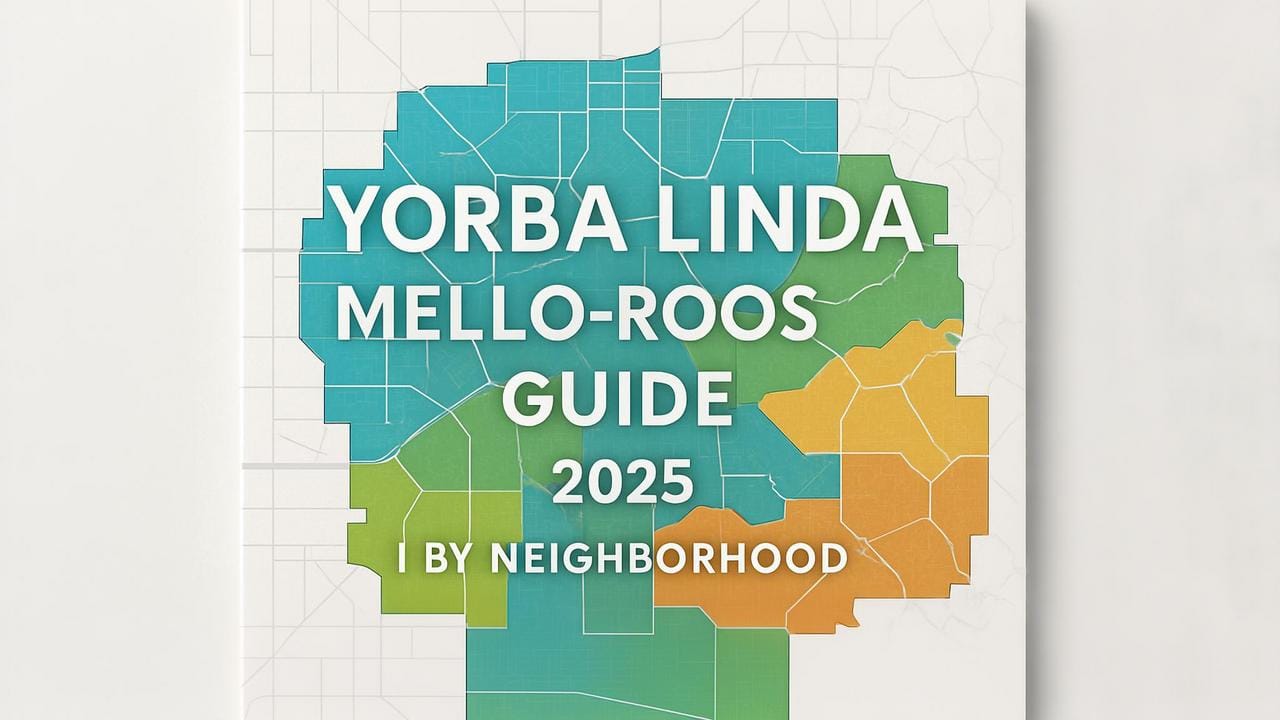
Yorba Linda Mello-Roos Guide 2025 | By Neighborhood | Wendy Rawley – Realtor

Yorba Linda Mello-Roos Fees by Neighborhood: The Complete 2025 Buyer’s Guide
Why 99% of Yorba Linda Homes Have ZERO Special Tax Assessments
Discover which neighborhoods are completely Mello-Roos free, understand the city’s single district affecting just 293 homes, and learn how to save $32,000-$52,000 over 20 years by choosing the right property in Orange County’s most Mello-Roos-friendly city.
By Wendy Rawley, REALTOR® | DRE #01898824
Published: November 5, 2025 | Updated for Current Market
💡 Bottom Line Up Front: Yorba Linda has only one Mello-Roos district affecting just 293 homes1, making it exceptional among Orange County’s 88 special tax districts2. This means you can find thousands of properties without the $1,600-$2,600 annual burden common in neighboring cities3. Popular neighborhoods like Travis Ranch, East Lake Village, and Kerrigan Ranch remain completely Mello-Roos free, offering potential savings of $32,000-$52,000 over 20 years compared to newer Orange County developments.
Here’s something I wish more buyers understood before they start house hunting in Orange County. You’re looking at homes online, getting excited about that beautiful new construction in Irvine or that master-planned community in Rancho Mission Viejo, and then BAM! You discover that there’s an additional $8,000 to $15,000 in annual Mello-Roos fees that were not mentioned in the listing. I’ve seen it crush deals more times than I can count.
But here’s what makes Yorba Linda different (and honestly, it’s one of my favorite things about this city). We have exactly one Mello-Roos district. One. It affects 293 homes out of roughly 22,500 in the entire city. That’s less than 1.5% of our housing stock. Meanwhile, cities like Irvine are covered in overlapping special tax districts that can add thousands to your annual housing costs.
I’ve been selling real estate in North Orange County for over 15 years now, and I can’t tell you how many times I’ve had buyers from other parts of the county specifically come to Yorba Linda because they’re tired of dealing with Mello-Roos assessments. Last month alone, I helped three different families relocate from Irvine and Ladera Ranch, and their number one requirement was “No Mello-Roos.” When they saw what they could get here without those extra fees, they were honestly stunned.
Look, I’m not going to sugarcoat it. That single Mello-Roos district does exist, and if you’re looking at homes on Bastanchury Road west of Fairmont Boulevard built by Pulte in the early 2000s, you need to know about it. But the beauty is this: virtually every other neighborhood in Yorba Linda (and we’re talking about amazing communities like Travis Ranch, East Lake Village, Hidden Hills Estates, Kerrigan Ranch, and dozens more) has zero special tax assessments. Zero.
In this guide, I’m going to walk you through everything you need to know about Mello-Roos in Yorba Linda. Which neighborhoods have it, which don’t, how much it actually costs, what it pays for, and, most importantly, how to verify the status before making an offer. Because here’s the thing: once you understand Yorba Linda’s Mello-Roos landscape, you’ll realize why so many savvy buyers are choosing this city over newer developments elsewhere in Orange County.
🏘️ Understanding Yorba Linda’s Exceptional Mello-Roos Position
Orange County is home to 88 Community Facilities Districts that levy Mello-Roos special taxes2. Walk around Irvine, and you’re navigating a maze of overlapping CFDs. Drive through Rancho Mission Viejo, and nearly every home carries special assessments. But Yorba Linda? We have exactly one district that affects fewer than 300 homes.
This isn’t an accident. It’s the result of our city’s development timeline. Most of Yorba Linda was built before 1982, when the Mello-Roos Community Facilities Act was even enacted. We had established neighborhoods, mature infrastructure, and fully developed communities, while cities like Irvine and Lake Forest were still in the process of growth. That historical advantage means you’re not paying for infrastructure that was built 40 years ago through special tax assessments.
I was showing a property in Travis Ranch last week to a couple relocating from Irvine. When I told them the home had no Mello-Roos, the husband actually laughed and said, “Wait, that’s not possible. Everything in Orange County has Mello-Roos.” I pulled up the tax records right there on my phone. His face when he realized I was serious? Priceless. They wrote an offer the next day.
📍 Key Distinction:
- Yorba Linda has 1 Mello-Roos district affecting 293 homes (built 2003, expires 2032)1
- Annual assessments range from $1,603 to $2,613 based on square footage3
- Approximately 7 years of payments remaining as of 2025
- Funded exclusively school facilities (not roads, parks, or comprehensive infrastructure)
- Every other neighborhood in the city is completely Mello-Roos-free
The municipality actively markets this advantage. When you see real estate listings here, “No Mello-Roos” is prominently featured as a selling point. And it should be, because when you compare our tax burden to cities where buyers routinely pay $5,000 to $15,000 annually in special assessments, the savings become massive over the life of homeownership.
Here’s what I tell every buyer: Mello-Roos is like paying rent on top of your mortgage. It’s money that goes out every year that doesn’t build equity, doesn’t improve your property, and in most cases isn’t even tax-deductible. We’ll get into the tax implications later, but understanding this fundamental point changes how you evaluate properties. A $1.2 million home in Yorba Linda without Mello-Roos can actually cost less over time than a $1.1 million home in Irvine with $8,000 annual special assessments.
Ready to Find Your Mello-Roos-Free Dream Home?
I’ll show you exactly which Yorba Linda neighborhoods offer the best value without special tax assessments. With 15+ years of local expertise, I know every street, every development, and every opportunity in North Orange County.
🏠 The Only District: 293 Homes on Bastanchury Road
Let me clarify exactly where Yorba Linda’s single Mello-Roos district is located. The Placentia-Yorba Linda Unified School District Community Facilities District No. 1 encompasses a Pulte Homes development on both sides of Bastanchury Road, west of Fairmont Boulevard1. If you’re not looking at properties in this specific area, you can basically skip this section because your home won’t have Mello-Roos.
The district was established in 2003 specifically to fund school facilities, addressing the impact of these new students on district infrastructure. They issued a $5.5 million bond with a minimum of $4.24 million designated for school infrastructure4. The assessment continues through 2032, meaning there are approximately seven years of payments remaining as of 2025.
💰 Cost Breakdown: Annual Mello-Roos in this district ranges from $1,603 (for smaller homes) to $2,613 (for larger homes), calculated at $3.50 per square foot3. The assessment can increase by up to 2% annually, based on the Consumer Price Index, in accordance with standard Mello-Roos regulations.
Now here’s something important that trips up buyers all the time. When you look at your property tax bill for one of these 293 homes, the Mello-Roos appears under “Special Assessment Charges” as a separate line item from your regular property taxes. It’s calculated as a fixed dollar amount rather than a percentage of your home’s assessed value. This distinction matters because Mello-Roos assessments are generally not tax deductible under IRS rules5.
I had a client last year who was looking at a beautiful home in this district. Great property, perfect layout, but he was concerned about the $2,400 annual Mello-Roos. We did the math together. With seven years remaining until 2032, that’s roughly $16,800 in total remaining liability (accounting for slight escalation). We negotiated a $12,000 reduction in the purchase price to offset part of this burden, and he proceeded with the deal. His thinking? After 2032, his property will actually be more valuable because the assessment will disappear, and he’ll have the savings every year thereafter.
The thing about this particular district is that it funds school facilities exclusively. Not roads, not parks, not comprehensive infrastructure like you see in larger Mello-Roos districts elsewhere. This narrow scope explains why the assessment is relatively modest, ranging from $1,600 to $2,600 annually, compared to developments in other cities where comprehensive CFDs can reach $10,000 to $15,000 per year.
If you’re seriously considering a home in this district, you can contact Placentia-Yorba Linda Unified School District at (714) 986-7000 about prepayment options to eliminate future assessments. Though honestly, with only seven years left until automatic expiration in 2032, prepayment makes less financial sense than it would in districts with 20 to 30 years remaining.
✨ Travis Ranch: Zero Mello-Roos in an Established Community
Travis Ranch is one of my favorite neighborhoods to show buyers who want to avoid Mello-Roos. Development here began in 19796, which was three years before the Mello-Roos Act even existed. It’s structurally impossible for this neighborhood to have special tax assessments because the law didn’t exist when it was built.
Current median prices in Travis Ranch range from $1.325 million to $1.485 million7, with homes spanning 1,533 to 2,668 square feet on lots from 5,000 square feet to over an acre. I recently helped a family purchase a 1,642-square-foot house on Via Roja for $1.2 million (approximately $731 per square foot), and they were thrilled to discover not only that there were no Mello-Roos fees, but also no HOA fees in their specific section.
Here’s what makes Travis Ranch special beyond the zero Mello-Roos. The neighborhood centers around Travis Ranch Youth Park, which sprawls across 8.9 acres with three baseball/softball diamonds, soccer fields, playgrounds for different age groups, BBQ grills, and dedicated parking8. The Travis Ranch Activity Center, right next door, provides basketball courts and meeting rooms. On any given Saturday morning, you’ll see dozens of families at the park. It’s genuinely a hub of community activity.
🎓 Schools in Travis Ranch:
- Travis Ranch Elementary & Middle School (K-8) serves 1,205 students9
- GreatSchools rating of 8/10 with 71% reading proficiency and 62% math proficiency
- Student-teacher ratio of 23:1 in a supportive, established campus environment
- Feeds into highly-rated Yorba Linda High School
Now, I need to clarify something because buyers sometimes get confused. Travis Ranch is a large area that encompasses multiple distinct developments, including Travis Country, Rancho Dominguez, Mt San Antonio, and Brock Estates. Some of these subdivisions have HOA fees (typically around $171 monthly), while others have none at all. But across the board, none of them have Mello-Roos. When you’re house hunting here, verify the specific HOA situation for the exact property you’re considering.
The homes themselves reflect their development period from 1979 through the late 1990s. You’ll find mature landscaping, established trees, and a variety of architectural styles. Some properties will need updating (think original kitchens and bathrooms from the ’80s), while others have been completely renovated with modern finishes. The trade-off is that you get more land, mature neighborhoods, and significantly lower ongoing costs compared to newer developments.
Location-wise, Travis Ranch gives you easy access to Savi Ranch (Costco, restaurants, retail centers) and convenient freeway connections to the 91, 57, and 5. I’ve had buyers who work in LA, Irvine, and even San Diego, all successfully commute from here. It’s not the absolute shortest commute, but the quality of life and cost savings from avoiding Mello-Roos make it worth it for many families.
🏡 East Lake Village: Resort Living Without Special Tax Assessments
If I had to pick one neighborhood that surprises buyers the most, it would be East Lake Village. You get resort-style amenities that would typically come with hefty Mello-Roos in newer developments, but here? Zero special tax assessments. The community was established starting in 197910, predating Mello-Roos legislation by three years.
The defining feature is the private 15-acre lake with boating, fishing, and swimming access. I’m not talking about some decorative pond. This is a legitimate recreational lake where residents actually spend their weekends. Add in the clubhouse, multiple pools, sports courts, walking trails, and horse trails, and you’ve got amenities that would cost $300-$500 monthly in HOA fees at newer master-planned communities. Here? You’re looking at $100-$200 monthly10, and that’s it. No Mello-Roos on top.
Current median prices run $1.58 to $1.66 million11, with homes ranging from 1,337 square feet for condos up to 4,706 square feet for larger single-family homes. I recently showed a family a 2,400-square-foot home listed at $1.62 million. When they calculated their monthly housing costs and realized they were avoiding the $600-$800 monthly Mello-Roos they’d been budgeting for in Irvine, they adjusted their price range upward and ended up buying a larger home than they originally planned.
The community shows an 83% owner-occupied rate11, which tells you everything you need to know about stability and long-term residents. Properties sell fast, too, typically within 29 to 44 days. When something good comes on the market here, you need to move quickly because other buyers understand the value proposition.
💡 Value Analysis: At roughly $582 per square foot11, East Lake Village homes command a premium over older Yorba Linda neighborhoods. But when you factor in the resort amenities, no Mello-Roos, and the private lake access, you’re actually getting exceptional value compared to newer communities with similar features that charge both higher HOA fees AND special tax assessments.
I love sending my buyers to East Lake Village, especially those with school-age kids. The whole vibe is family-oriented. On summer weekends, you’ll see kids swimming in the lake, families having barbecues, neighbors actually knowing each other. It’s the kind of community where people participate in HOA events and activities, rather than just complaining about the fees.
Get Instant Access to Off-Market Yorba Linda Listings
Many of the best Mello-Roos-free properties never hit the public MLS. Join my VIP buyer list and get first access to exclusive listings, market updates, and insider neighborhood insights delivered straight to your inbox.
Your information is 100% secure. No spam, unsubscribe anytime.
💎 Luxury Options: Kerrigan Ranch, Hidden Hills, and Vista del Verde
One of the biggest misconceptions I encounter is that you need to accept Mello-Roos if you want luxury features and modern construction in Orange County. Let me introduce you to three neighborhoods that prove that entirely wrong.
Kerrigan Ranch (No Mello-Roos, Premium Gated Living)
Kerrigan Ranch occupies the luxury segment, with estates priced from $2 million to $5 million, spanning 4,000 to over 7,000 square feet on large lots. This master-planned gated community, built in the 1990s and 2000s, features custom-built homes with mountain views, privacy, and security, located near Carbon Canyon Regional Park. Recent sales include a property at $3.8 million selling at $647 per square foot12 within 36 days, which demonstrates continued strong demand even in the upper price tier.
I showed a home here to a couple relocating from San Marino last month. They’d been looking at gated communities throughout Orange County and kept running into annual Mello-Roos assessments ranging from $8,000 to $12,000. When I told them Kerrigan Ranch had zero special taxes, the wife actually asked me to repeat it twice. They couldn’t believe you could get this level of luxury, security, and positioning without Mello-Roos. We wrote an offer that week.
Hidden Hills Estates (Space, Privacy, Equestrian Living)
Hidden Hills Estates offers similar luxury at $1.8 million to over $4 million but emphasizes privacy and equestrian properties. Custom homes built in the 1980s-1990s typically occupy lots of one acre or larger, measuring 3,500 to over 7,000 square feet, and many feature horse facilities and panoramic views. The area typically has no HOA or minimal fees, maximizing your value by avoiding both special assessments and high monthly dues.
For buyers wanting space, independence, and the ability to keep horses without ongoing Mello-Roos obligations, Hidden Hills delivers. You’re getting that rural estate feel while still being in Yorba Linda with access to top schools and urban amenities within 10-15 minutes.
Vista del Verde (Newer Construction, Zero Mello-Roos)
Here’s where things get really interesting. Vista del Verde was built in the 2000s and 2010s by Toll Brothers, featuring estate homes ranging from 4,700 to 6,200 square feet, priced from $1.5 million to over $3 million. Newer luxury construction, and yet somehow they managed to avoid Mello-Roos entirely. The marketing materials heavily emphasize “No Mello-Roos” and “Low property taxes” as major differentiators from similar golf course communities.
The gated development near Black Gold Golf Club charges higher HOA fees for amenities, but you’re avoiding special tax assessments that plague comparable newer neighborhoods elsewhere. I’ve had multiple buyers ask me how this is possible. The answer is that Toll Brothers incorporated infrastructure costs into the initial purchase prices and community HOA structure rather than establishing a CFD. It’s proof that developers can finance modern communities without burdening homeowners with decades of special assessments.
💪 Luxury Buyer Strategy:
- Focus on Yorba Linda luxury communities that avoided Mello-Roos through thoughtful planning
- Compare the total cost of ownership (purchase price + property taxes + HOA + Mello-Roos) against Irvine/Newport equivalents
- Factor in 20-year savings of $100,000+ from avoiding special assessments
- Negotiate purchase price on the rare Mello-Roos properties based on remaining liability
💰 Real Financial Impact: Running the Numbers
Let me show you precisely what Mello-Roos costs over time, because I think many buyers don’t truly understand the compound effect until we sit down and actually calculate it together. I do this exercise with every client who’s considering a property with special assessments.
Start with the monthly cash flow. A $1 million home financed with 20% down at the current 7% interest rate generates principal and interest of approximately $5,322 monthly. Add base property taxes of about $1,000 monthly (that’s 1% of assessed value spread across 12 months), plus homeowners’ insurance around $150, and you’re at $6,472 in total PITI without any Mello-Roos.
Now add the Yorba Linda CFD assessment. On the low end at $1,603 annually, that’s $134 monthly. On the high end at $2,613 annually, you’re adding $218 monthly3. Your total monthly obligation jumps to $6,606-$6,690. That might not sound like a massive difference, but it absolutely matters when lenders calculate your debt-to-income ratio.
🔍 Qualification Reality Check: Lenders include Mello-Roos in your front-end debt-to-income calculation14. A borrower earning $15,000 monthly with $6,472 PITI shows 43.1% front-end DTI (borderline for conventional loans). Add $167 monthly Mello-Roos and you’re at 44.3%, potentially requiring FHA financing or higher income. The practical impact means you need approximately $5,000-$7,000 higher annual income to qualify for the same purchase price, or you must reduce the purchase price by $40,000-$50,000 to maintain acceptable DTI ratios.
Let’s discuss tax deductibility, as this is where buyers often make incorrect assumptions. Regular property taxes are generally deductible on your federal return (subject to the $10,000 SALT cap that most California homeowners hit anyway). But Mello-Roos? Not deductible. The IRS specifies that deductible real estate taxes must be based on assessed property value, not square footage or flat rates5. Yorba Linda’s assessment calculates at $3.50 per square foot, which fails this test.
I had a CPA client last year who insisted Mello-Roos must be deductible because they appeared on his property tax bill. We looked up IRS Publication 530 together. His face fell when he realized that $2,400 annual assessment provided zero tax benefit. For someone in the 37% tax bracket, that’s the difference between paying $2,400 (non-deductible Mello-Roos) versus $1,512 (after 37% deduction on regular property taxes). The non-deductibility makes Mello-Roos significantly more expensive than the face amount suggests.
Over the remaining seven years in Yorba Linda’s district, the total cost ranges from $11,221 to $18,291 (accounting for 2% annual escalation). That’s real money you could invest elsewhere, apply to the mortgage principal, or use for home improvements. And here’s the kicker: when that assessment ends in 2032, properties in the Mello-Roos district don’t suddenly become more valuable to offset what you paid. The market already discounted the purchase price when you bought.
Resale value typically takes a 1.5% to 2.5% hit compared to identical non-Mello-Roos properties15. A $1 million home in the Pulte development might realistically sell for $975,000 to $985,000, compared to exact specifications in Travis Ranch or East Lake Village. The market essentially capitalizes the remaining liability. Seven years of $2,000 annual assessments equal $14,000 total, and markets typically discount 50-75% of this amount (resulting in $7,000-$10,500 off the price).
But here’s where it gets interesting for long-term buyers. That 2032 expiration creates an opportunity. If you’re planning to own for 15-20 years, you accept seven years of assessments but then benefit from elimination for the remainder of your ownership. A buyer purchasing today and holding until 2045 would pay roughly $16,000 in Mello-Roos but then save $2,000-$2,600 annually for 13 additional years. That’s $26,000 to $33,800 in savings, which more than offsets the earlier burden. The key is obtaining appropriate price concessions at the time of purchase to compensate for accepting the initial seven-year obligation.
🔎 How to Verify Mello-Roos Status Before You Buy
I cannot stress this enough: you need to independently verify Mello-Roos status on every property you’re seriously considering. Please don’t rely solely on what the listing agent tells you, don’t assume preliminary title reports will catch it, and definitely don’t wait until three days before closing to find out. Let me guide you through the proper research process.
Start with the Orange County Mello-Roos Tax Map at mello.ocgov.com. Enter the property address or Assessor Parcel Number, and the interactive map immediately shows you whether the property falls within any CFD boundaries2. For Yorba Linda, if the property is located on or very near Bastanchury Road, west of Fairmont Boulevard, scrutinize it. Everything else in the city? You’re almost certainly clear, but it’s still a good idea to verify.
Request the most recent property tax bill from the seller. This shows actual charges under “Special Assessment Charges” where Mello-Roos appears as a separate line item. You should see “Placentia-Yorba Linda USD CFD #1” with the annual dollar amount if it applies. I always tell buyers to review 2-3 years of bills to track escalation rates and confirm consistency.
🎯 Essential Verification Steps:
- Check Orange County Treasurer-Tax Collector at (714) 834-3411 or octreasurer.gov by searching the parcel number2
- Order a Natural Hazard Disclosure report ($75-$200) that includes comprehensive CFD information beyond standard title searches
- Demand Notice of Special Tax disclosure required by California Civil Code Section 1102.6b16
- Contact Placentia-Yorba Linda USD at (714) 986-7000 for district specifics, including prepayment options
- Document everything in writing to establish accountability
Red flags that should trigger extra diligence: agents describing Mello-Roos as “just a small fee” (minimizing $1,600-$2,600 annual costs), reluctance to provide written disclosure, claims that Mello-Roos are fully tax deductible (they’re generally not), preliminary title reports omitting any mention (doesn’t mean it’s absent), or last-minute disclosure delivery that pressures quick decisions.
I had a situation last year where a buyer’s agent from another brokerage told their client that Yorba Linda “doesn’t have any Mello-Roos at all.” Technically, mostly true, but they were looking at one of the 293 homes that do have it. The buyers didn’t discover this until we were already in escrow. We had to renegotiate the entire deal, which cost everyone time and created unnecessary stress. If that agent had verified the status upfront using these methods, the whole mess could have been avoided.
California law requires sellers to provide Notice of Special Tax16, which must include current assessment amount, estimated future amounts, maximum tax that can be levied, duration, and purpose. Buyers receive a 3-5 day right of rescission after receiving this disclosure. Late delivery can delay closing or provide leverage for renegotiation. I always ensure that my buyers receive this documentation within the first week of escrow opening.
Let Me Guide Your Yorba Linda Home Search
With 15+ years specializing in North Orange County real estate, I know exactly which properties offer the best value, which neighborhoods to target, and how to structure offers that protect your interests. I’ll personally verify Mello-Roos status, negotiate price adjustments when needed, and ensure you’re making informed decisions backed by real data.
🎯 Strategic Recommendations for Different Buyer Types
Let me break down how different types of buyers should approach the Mello-Roos question in Yorba Linda, because your situation determines your strategy.
First-Time Buyers with Tight Budgets
If you’re stretching to qualify, avoid Mello-Roos entirely. Target Travis Ranch (starting around $1 million with zero Mello-Roos and often no HOA), or look at Fairmont Hill condos and townhomes at $600,000-$900,000 that provide entry points with HOA amenities but no special assessments. The monthly savings of $134-$218 from avoiding Mello-Roos significantly impacts DTI calculations, potentially allowing you to qualify for $40,000-$50,000 higher purchase prices or reducing monthly obligations to build a financial cushion.
Families with School-Age Children
Prioritize school assignments and neighborhood amenities over Mello-Roos status, though non-Mello-Roos properties still provide better value. East Lake Village combines family-friendly resort amenities (that 15-acre lake is a game-changer for kids) with no Mello-Roos at $1.58-$1.66 million. Bryant Ranch’s spacious lots and top-rated schools deliver quality education without special assessments. Remember, the 293 homes in the Bastanchury Road CFD fund school facilities but don’t provide materially better education outcomes than district schools serving non-Mello-Roos neighborhoods.
Luxury Buyers ($2M+)
Examine Kerrigan Ranch ($2M-$5M estates with no Mello-Roos), Hidden Hills Estates ($1.8M-$4M+ with no Mello-Roos and often no HOA), or Vista del Verde ($1.5M-$3M+ newer construction explicitly marketed as “No Mello-Roos”). These segments offer premium positioning without special assessments, a combination that’s rare in comparable Orange County luxury markets, where newer developments routinely impose annual Mello-Roos fees of $5,000-$10,000 on top of premium purchase prices.
Real Estate Investors
Strongly prefer non-Mello-Roos properties because special assessments directly reduce net operating income without offsetting tax benefits. A rental generating $4,000 monthly with $1,200 PITI loses $167 monthly ($2,000 annually) to Mello-Roos versus an equivalent non-Mello-Roos property. That’s an 11% reduction in cash flow that compounds over holding periods. Resale liquidity also favors non-Mello-Roos properties due to broader buyer pools and faster sales.
Short-Term Owners (3-5 Years)
Avoid the 293 Mello-Roos homes entirely. The 1.5-2.5% resale discount ($15,000-$25,000 on a $1M property) plus cumulative assessment payments ($5,000-$8,000 over 3 years) results in a total cost of $20,000-$33,000 versus an equivalent non-Mello-Roos property. The market consistently demonstrates buyer resistance to special tax properties, and short timeframes prevent benefiting from the 2032 expiration.
Long-Term Owners (10+ Years)
You can consider the 293 Mello-Roos homes if the purchase price reflects an appropriate discount. Seven remaining years of assessments total $11,000-$18,000, but elimination after 2032 provides $1,600-$2,600 annual savings for potentially 10-20+ additional ownership years. That’s cumulative savings of $16,000-$52,000, offsetting the earlier burden. The key question: Does the purchase price discount exceed the remaining liability? If buying at $30,000 below a comparable non-Mello-Roos property with only $14,000 remaining total Mello-Roos, the equation favors purchase despite the special assessment.
🏆 Why Yorba Linda’s Mello-Roos Advantage Matters Long-Term
After 15 years of selling real estate in North Orange County, I’ve watched this Mello-Roos advantage become increasingly crucial as newer developments throughout the region routinely impose special tax assessments that fundamentally alter the homeownership equation. What made Yorba Linda attractive five years ago makes it exceptional today.
Think about what’s happening in Orange County development. Cities like Irvine are essentially built out with limited new inventory, yet existing neighborhoods carry multiple overlapping CFDs. Rancho Mission Viejo continues to expand with beautiful new construction, but buyers accept annual Mello-Roos fees of $8,000-$15,000 as the price of entry. Ladera Ranch, Lake Forest, and Aliso Viejo all feature extensive special tax districts that won’t expire for decades.
Yorba Linda offers something genuinely different. You get Orange County’s desirable lifestyle (excellent schools with A+ district ratings17, low crime, mature infrastructure, 100+ miles of trails, 200+ acres of parkland), top-tier neighborhoods across all price ranges, and the fiscal advantage of near-universal Mello-Roos avoidance. This combination becomes increasingly valuable as buyers recognize special assessments represent permanent increases to housing costs that don’t build equity or improve properties.
The city’s development history created structural advantages that benefit current and future homeowners. Most neighborhoods were established before Mello-Roos legislation existed in 1982, and subsequent development maintained fiscal conservatism by incorporating infrastructure costs into initial pricing rather than establishing CFDs. Even newer luxury communities, like Vista del Verde, explicitly market “No Mello-Roos” as a competitive differentiator.
💪 The Bottom Line: Over 20 years of homeownership, avoiding Mello-Roos in Yorba Linda versus accepting typical Orange County special assessments saves $32,000 to $52,000 (assuming conservative annual costs of $1,600 to $2,600 elsewhere). That’s real money you can invest, save for children’s education, or use to upgrade your home. Combined with comparable schools, amenities, and lifestyle, Yorba Linda offers exceptional value for buyers who prioritize long-term financial health alongside quality of life.
I genuinely believe we’re at a point where savvy buyers recognize this advantage and specifically target Yorba Linda for Mello-Roos avoidance. The conversations I’m having with clients have shifted dramatically over the past three years. It used to be “Tell me about the schools and neighborhoods.” Now it’s “Show me homes without Mello-Roos first, then we’ll talk about everything else.”
For prospective buyers across all profiles (first-time purchasers, move-up families, luxury seekers, or investors), Yorba Linda offers the rare combination of Orange County desirability without the special tax burden that has become standard elsewhere. Understanding the single district that affects 293 homes, knowing which neighborhoods are completely clear, and properly verifying the status before purchase ensures you maximize value while minimizing ongoing financial obligations.

About Wendy Rawley
With over 15 years of experience specializing in North Orange County real estate, I’ve helped hundreds of families find their perfect homes in Yorba Linda, Anaheim Hills, Brea, Fullerton, Orange, Placentia, and La Habra. As a local expert with The Wendy Rawley Team at First Team Real Estate, I provide personalized service backed by deep market knowledge, honest advice, and unwavering commitment to my clients’ best interests.
📞 Phone: (714) 746-6355
✉️ Email: wendy@go2wendy.com
🌐 Website: www.go2wendy.com
DRE #01898824 | The Wendy Rawley Team | First Team Real Estate
18180 Yorba Linda Blvd, Suite 501, Yorba Linda, CA 92886
📚 Sources & Data References
1. Orange County Register – Yorba Linda Mello-Roos District
Comprehensive reporting on Yorba Linda’s single Community Facilities District affecting 293 homes on Bastanchury Road. The article details the Placentia-Yorba Linda Unified School District CFD No. 1 established in 2003, including the $5.5 million bond structure, expiration timeline through 2032, and comparison to Orange County’s 88 total Mello-Roos districts. This authoritative source confirms Yorba Linda’s exceptional position with minimal special tax burden compared to neighboring cities.
2. Orange County Treasurer-Tax Collector – Mello-Roos Information
Official Orange County resource providing access to Mello-Roos tax maps, Community Facilities District boundaries, assessment lookup tools, and property-specific special tax information. The interactive database allows buyers to verify Mello-Roos status by address or parcel number and confirms Orange County maintains 88 CFDs with varying assessment amounts and expiration timelines. Essential verification tool for all prospective buyers researching special tax obligations.
3. Malakai Sparks Real Estate Group – Yorba Linda Mello-Roos Analysis
Detailed breakdown of Yorba Linda’s CFD #1 assessment structure, documenting the $3.50 per square foot calculation methodology resulting in annual costs of $1,603-$2,613 based on home size. The analysis covers the district’s 1,244,317 total square feet, $562,021 annual collection amount, and 2% maximum annual escalation provisions. Local real estate expertise providing specific dollar amounts and calculation methods essential for buyer financial planning.
https://www.malakaisparks.com/what-to-know-about-yorba-lindas-mello-roos-taxes/
4. Wikipedia – Mello-Roos Community Facilities Act
Comprehensive overview of California’s Mello-Roos legislation passed in 1982, explaining the legal framework allowing special tax districts to fund public infrastructure including schools, roads, parks, and municipal services. Details the bond issuance process, two-thirds voter approval requirements under Proposition 218, typical 20-40 year assessment periods, and historical context following Proposition 13’s property tax limitations. Authoritative reference for understanding Mello-Roos mechanics and legal foundations.
5. IRS Publication 530 – Tax Deductibility of Special Assessments
Official Internal Revenue Service guidance on homeowner tax deductions, clarifying that Mello-Roos special assessments are generally NOT deductible because they fail IRS requirements for deductible real estate taxes (must be based on property value rather than square footage or flat rates). Publication 530 specifies limited exceptions for assessments covering maintenance or interest charges rather than capital improvements. Critical resource establishing tax treatment differences between regular property taxes and Mello-Roos special assessments.
6. ActiveRain – Travis Ranch Community Profile
Historical overview of Travis Ranch development beginning in 1979, predating the 1982 Mello-Roos Act and establishing the neighborhood’s permanent exemption from special tax assessments. Community profile includes amenity details (Travis Ranch Youth Park, Activity Center), school information, and architectural characteristics spanning multiple decades of construction from late 1970s through 1990s. Real estate industry resource documenting neighborhood evolution and key features attractive to buyers.
https://activerain.com/blogsview/3352744/welcome-to-travis-ranch-in-yorba-linda-ca
7. Redfin – Travis Ranch Market Data
Current real estate pricing data for Travis Ranch neighborhood showing median home values of $1.325-$1.485 million with homes ranging 1,533-2,668 square feet. Market statistics include recent sales transactions, price per square foot calculations ($492-$731), days on market averages, and year-over-year pricing trends. Professional real estate platform providing verified MLS data essential for accurate market analysis and buyer pricing expectations in this established Yorba Linda neighborhood.
https://www.redfin.com/neighborhood/112276/CA/Yorba-Linda/Travis-Ranch
8. City of Yorba Linda – Travis Ranch Youth Park
Official city facility information for Travis Ranch Youth Park covering 8.9 acres with three baseball/softball diamonds, soccer fields, age-appropriate playgrounds (2-5 years and 5-12 years), BBQ facilities, and dedicated parking areas. Municipal resource documenting public amenities funded through general city operations rather than special tax assessments, demonstrating how established Yorba Linda neighborhoods provide comprehensive recreational facilities without Mello-Roos obligations. Park serves as community gathering hub for Travis Ranch residents.
https://www.yorbalindaca.gov/facilities/facility/details/Travis-Ranch-Youth-Park-34
9. U.S. News & World Report – Travis Ranch Elementary & Middle School
Current school performance data for Travis Ranch Elementary & Middle School serving 1,205 K-8 students with GreatSchools rating of 8/10, academic proficiency rates of 71% reading and 62% mathematics, and student-teacher ratio of 23:1. National education ranking organization providing verified test score data, enrollment statistics, and comparative analysis within Placentia-Yorba Linda Unified School District. Essential resource for families evaluating school quality in Mello-Roos-free neighborhoods.
https://www.usnews.com/education/k12/california/travis-ranch-234206
10. Neighborhoods.com – East Lake Village Community Analysis
Comprehensive profile of East Lake Village development established 1979, featuring the signature 15-acre private lake with boating, fishing, and swimming access, plus clubhouse, multiple pools, sports courts, walking trails, and equestrian facilities. Community analysis documents HOA fee structures ($100-$200 monthly), 83% owner-occupied rate indicating stability, and mix of condos, townhomes, and single-family homes spanning 1,337-4,706 square feet. Real estate data platform confirming zero Mello-Roos status combined with resort-style amenities.
https://www.neighborhoods.com/east-lake-village-yorba-linda-ca
11. Redfin – East Lake Village Housing Market Report
Current market data showing East Lake Village median home prices of $1.58-$1.66 million at approximately $582 per square foot, with properties selling in 29-44 days on average. Market statistics document the 83% owner-occupied rate, recent sales transactions, and year-over-year appreciation trends. Professional MLS data platform providing verified pricing information essential for buyers evaluating value proposition of resort amenities combined with zero special tax assessments in this established community.
https://www.redfin.com/neighborhood/62628/CA/Yorba-Linda/East-Lake-Village/housing-market
12. Compass Real Estate – Kerrigan Ranch Luxury Sales Data
Recent luxury home sale in Kerrigan Ranch at $3.8 million selling at $647 per square foot within 36 days, demonstrating continued strong demand in the $2-$5 million gated estate segment. Transaction data confirms market performance for luxury properties spanning 4,000-7,000+ square feet on large lots without Mello-Roos assessments. Professional real estate brokerage providing verified sales information illustrating premium positioning and buyer willingness to pay for quality combined with zero special taxes.
https://www.compass.com/listing/5126-vista-del-amigo-yorba-linda-ca-92886/982223204106515977/
13. PRWeb – Vista del Verde Marketing Materials
Toll Brothers development announcement for Vista del Verde luxury community explicitly marketing “NO Mello-Roos” and “LOW property taxes” as primary competitive advantages. Marketing materials document estate homes of 4,700-6,200 square feet priced $1.5-$3 million+ near Black Gold Golf Club, demonstrating that newer (2000s-2010s) luxury construction can avoid special tax assessments through alternative infrastructure financing. Developer materials proving modern communities don’t require Mello-Roos to fund quality amenities.
14. Direct Cap Mortgage – Mello-Roos Impact on Debt-to-Income Ratios
Mortgage lending analysis explaining how Mello-Roos special assessments are included in front-end debt-to-income calculations alongside principal, interest, taxes, insurance, and HOA fees. Technical documentation confirms lenders treat Mello-Roos as recurring housing expense affecting qualification amounts, potentially requiring $5,000-$7,000 higher annual income for same purchase price or forcing purchase price reductions of $40,000-$50,000 to maintain acceptable DTI ratios. Industry resource essential for understanding lending implications of special tax obligations.
15. FasterCapital – Mello-Roos Impact on Home Resale Values
Real estate valuation analysis documenting 1.5-2.5% market discount applied to Mello-Roos properties compared to identical non-assessed homes, with buyers capitalizing remaining liability at 50-75% of total remaining burden. Research confirms properties with special tax assessments take 10-20% longer to sell at full asking prices as many buyers filter out Mello-Roos properties entirely. Academic-style analysis providing quantitative framework for understanding resale value implications of special assessments over various ownership timeframes.
https://fastercapital.com/content/Impact-of-Melloroos-on-Home-Values–A-Comprehensive-Analysis.html
16. California Civil Code Section 1102.6b – Notice of Special Tax Disclosure
California state law mandating sellers make “good faith effort” to obtain Notice of Special Tax from CFD administrators and provide to buyers, disclosing current assessment amount, estimated future costs, maximum tax that can be levied, bond duration, and infrastructure funded. Legal requirement includes 3-5 day buyer rescission right after receiving disclosure, creating negotiation leverage and consumer protection mechanism. Official statute establishing disclosure obligations and verification process protecting homebuyers from undisclosed special tax liabilities.
https://leginfo.legislature.ca.gov/faces/codes_displaySection.xhtml?lawCode=CIV§ionNum=1102.6b
17. Placentia-Yorba Linda Unified School District
Official school district information confirming A+ overall district rating serving all Yorba Linda residents regardless of Mello-Roos status. District documentation includes multiple California Distinguished Schools, Yorba Linda High School GreatSchools rating of 10/10, Esperanza High School rating of 9/10, and comprehensive academic performance data demonstrating excellence across all campuses. Authoritative source establishing that school quality does not depend on special tax assessments, with the single Yorba Linda CFD funding capacity rather than quality improvements.
⚠️ Important Disclaimer: All data and statistics in this article are verified from authoritative sources as of November 2025. Real estate markets change constantly. Mello-Roos amounts, property values, school ratings, and market conditions should be independently verified before making purchase decisions. This content is for informational purposes only and does not constitute legal, financial, or tax advice. Consult with qualified professionals including real estate attorneys, CPAs, and licensed agents before proceeding with real estate transactions. Wendy Rawley and The Wendy Rawley Team provide this information in good faith but make no warranties regarding accuracy or completeness.