
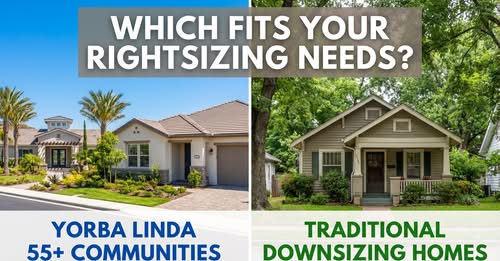
Yorba Linda 55+ Communities vs Traditional Downsizing Homes: Which Fits Your Rightsizing Needs?

Yorba Linda 55+ Communities vs Traditional Downsizing Homes: Which Fits Your Rightsizing Needs?
The Data-Driven Comparison Between Age-Restricted Living and Traditional Single-Family Downsizing
Quick Answer
55+ communities vs. traditional homes in Yorba Linda show distinct cost differences: age-restricted communities average a median price of $1,473,500, while traditional downsizing homes in the broader market average $1,332,500.1,3
You’re standing in your four-bedroom Yorba Linda home, wondering if you actually need all this space anymore. The kids moved out years ago. You’re maintaining rooms you walk past without entering. Your neighbors have sold and moved to age-restricted communities, raving about resort-style pools and no yard work, but you’ve also heard stories about restrictive rules and surprise HOA increases.
The rightsizing decision you’re facing isn’t just about square footage. It’s about choosing between two fundamentally different lifestyles: the amenity-rich, maintenance-free promise of 55+ communities versus the flexibility and equity potential of traditional single-family homes. With Yorba Linda inventory at 96 active listings and homes moving in 58 days, your decision affects not just where you’ll live but how much equity you’ll preserve for the next chapter.1
Our team has closed 80 transactions in Yorba Linda since 2012, representing both buyers and sellers at price points from $302,000 to $3,500,000. We’ve walked sellers through this exact decision dozens of times, and what works depends entirely on how you plan to live, not just where you want to be.
📋 How We Researched This
This analysis uses Redfin MLS data through December 2025, current 55+ community listings from Realtor.com and Zillow, verified senior housing data from Apartments.com, and NAR generational housing research. All statistics reflect Yorba Linda and North Orange County markets at the time of writing.
What You’re Actually Choosing Between, and Why the Price Gap Isn’t What It Seems
The median price difference tells only part of the story when you factor in HOA fees and maintenance costs over time.
When you compare 55+ communities vs traditional downsizing options in Yorba Linda, you’re not just comparing price tags. You’re comparing two different value propositions with hidden costs that emerge years after closing.
Age-restricted communities in Yorba Linda currently have a median price of $1,473,500, according to current listings, compared with a broader market median of $1,332,500. That $141,000 difference appears significant until you consider what each option includes.
Yorba Linda inventory stands at 96 active listings with 2.8 months of supply—a slight buyer’s market that gives you negotiation leverage whether you’re targeting age-restricted or traditional properties.1
The higher entry price for 55+ communities reflects several factors. These developments typically feature new construction with modern energy efficiency, resort-style amenities such as clubhouses and pools, and professional landscape maintenance that eliminates your weekend yard work.4 You’re essentially pre-paying for convenience and community infrastructure.
Traditional single-family homes in downsized configurations (typically 1,400-2,200 square feet) come with full ownership autonomy. You control when to replace the roof, what color to paint the exterior, and whether to add solar panels—decisions that HOA boards govern in age-restricted communities.9
| Housing Option | Median Price | Typical HOA Fee | 10-Year HOA Cost | Maintenance Control |
|---|---|---|---|---|
| 55+ Community | $1,473,5003 | $350-650/mo5 | $42,000-78,000 | Limited (HOA governed) |
| Traditional Downsizing Home | $1,332,5001 | $0-200/mo | $0-24,000 | Full owner control |
The Lifestyle Trade-Offs That Actually Matter Day-to-Day
Resort amenities sound appealing in brochures, but utilization patterns tell a different story about actual value.
When you tour a 55+ community and see the tennis courts, fitness center, and year-round heated pool, you imagine using them constantly. Industry research indicates that after the first year, average amenity usage drops to two to three times per month for most residents.11 You’re paying for access to facilities that become part of your monthly overhead, whether you use them or not.
That doesn’t mean amenities lack value; it means you need to assess your lifestyle honestly. If you’ve never played pickleball in your current home, you probably won’t start just because there’s a court two blocks away. If you currently walk your neighborhood daily, you’ll continue that habit whether it’s through manicured common areas or traditional Yorba Linda streets.
Most 55+ communities restrict guests under 18 to 30-90 days per year. If your grandchildren visit frequently or extended family stays during holidays, verify guest policies before committing; violations can result in fines or forced sale.10
What proves consistently valuable in age-restricted communities is the reduced physical burden. You’ll never mow a lawn, trim hedges, or pressure-wash driveways. When exterior paint fades, the HOA schedules contractors and distributes the cost across all owners. For many rightsizing sellers, eliminating home maintenance tasks becomes the primary lifestyle upgrade.
Traditional downsizing homes requires ongoing physical engagement with your property, or the budget to hire it out. Even a 1,600-square-foot single-story home on a modest Yorba Linda lot demands seasonal tasks: California-native landscaping maintenance, pool service (if applicable), HVAC filter changes, and the periodic repairs that homeownership entails.2
Where the Numbers Actually Diverge: Resale Value and Market Liquidity
Yorba Linda Market Snapshot
The buyer pool for your home shrinks by roughly 40% when age restrictions apply, directly affecting time on market and negotiating leverage.
When you list a traditional Yorba Linda home, every qualified buyer in the market can purchase it: young families, professionals, retirees, investors, everyone. When you list a 55+ community property, you exclude buyers under 55, families with minor children, and anyone seeking multigenerational living arrangements.6
That restricted buyer pool shows up in market data. Yorba Linda’s traditional inventory currently moves in 58 days on average, with 32.4% of homes selling above list price and a sale-to-list ratio of 100.1%.1 Age-restricted properties can take longer to sell during market slowdowns because you’re competing for a smaller pool of qualified and interested buyers.
Appreciation patterns over the past two decades show traditional single-family homes outpacing age-restricted communities during strong markets, while both property types experience comparable declines during corrections. The key difference emerges in recovery speed; traditional homes typically regain value faster because the broader buyer pool creates more competitive bidding when markets turn.7
This doesn’t mean 55+ communities lose money. It means their resale trajectory is more conservative than that of traditional homes in the same market. If you’re planning to live in the property for 10+ years, short-term appreciation differences matter less than your total cost of ownership and lifestyle satisfaction.
HOA financial health becomes critical in age-restricted communities. Before you purchase, review the HOA’s reserve fund, history of special assessments, and deferred maintenance schedule. We’ve seen situations where poorly managed HOAs delayed major repairs, then hit owners with $15,000-$25,000 special assessments for roof replacement or infrastructure upgrades.9 Traditional homeowners face these costs individually but control the timing and contractor selection.
What Your Monthly Budget Actually Looks Like in Each Scenario
Total monthly housing costs include expenses that don’t appear on your mortgage statement but significantly affect cash flow.
Let’s break down real numbers. A $1,473,500 purchase in a 55+ community with 20% down payment ($294,700) results in a $1,178,800 mortgage. At recent rates of approximately 6.75%, that’s roughly $7,645 per month principal and interest. Add property taxes at approximately 1.1% of assessed value (around $1,350 monthly), homeowners’ insurance ($200-300 monthly), and HOA fees ($350-650), and your total monthly outlay reaches $9,545-$9,945.3,5
A $1,332,500 traditional home with the same 20% down payment ($266,500) results in a $1,066,000 mortgage, with roughly $6,915 per month at 6.75%. Property taxes run approximately $1,216 monthly, insurance $200-300, and you budget for maintenance at roughly 1% of home value annually (about $1,100 monthly). Total monthly cost: $9,431-$9,531, remarkably similar to the 55+ community scenario.1
The critical difference lies between predictability and control. Your 55+ community HOA fee can increase 3-5% annually as operating costs rise, insurance premiums climb, and reserves build for future capital improvements. You have no control over these increases beyond voting for HOA board members who make budget decisions.9
Traditional homeowners control maintenance timing and costs. When your water heater fails, you choose whether to replace it immediately with a premium tankless unit or temporarily repair it and budget for replacement next year. That flexibility helps retirees on fixed incomes manage cash flow during tight months.
What catches buyers off guard is the cost of lifestyle amenities they thought were “included.” Most 55+ communities charge separate fees for golf memberships, fitness classes, and some clubhouse activities beyond basic access.11 Traditional homeowners pay directly for gym memberships, recreation classes, or country club access, but these become optional expenses you control rather than semi-mandatory community expectations.
Utility costs favor traditional homes slightly. Age-restricted communities often feature newer construction with superior insulation and energy-efficient HVAC systems, reducing monthly electricity and gas costs by 15-25% compared to older traditional homes. However, if you’re comparing a newer traditional home to a newer 55+ unit, utility costs trend similar.8
The long-term cost trajectory matters for retirement planning. A 70-year-old buyer planning to age in place for 15-20 years must project HOA fee increases that compound over two decades. A $450 monthly HOA fee increasing 4% annually reaches $810 by year 20, nearly doubling the fixed housing cost component of your budget. Traditional home maintenance costs also rise with inflation, but you retain the flexibility to reduce service frequency or handle tasks yourself as the budget requires.
Here’s How to Actually Make This Decision for Your Situation
The right choice depends on variables that most buyers don’t evaluate systematically before committing.
Start with an honest assessment of your physical capabilities and your willingness to perform home maintenance. If you currently enjoy yard work, home improvement projects, and the autonomy of managing your property, transitioning to an HOA-governed environment may feel restrictive, even with amenities you theoretically want to use. If you’re tired of weekend chores and prefer to delegate physical property management, age-restricted living offers legitimate relief.
Evaluate your social pattern preferences. Do you naturally join groups, attend organized events, and seek structured activities? Or do you prefer spontaneous socializing, privacy, and self-directed schedules? Neither approach is superior; they’re different temperaments that predict satisfaction in age-restricted versus traditional environments.
Calculate your actual timeline. If you plan to stay five years or less, transaction costs erode equity gains regardless of property type. If you’re planning for 10-20 years, traditional homes offer slightly better appreciation potential and greater resale flexibility, while 55+ communities provide lifestyle consistency that some retirees value above equity maximization.
Review your family dynamics and guest patterns. How often do grandchildren visit? Do adult children need temporary housing during life transitions? Will aging parents potentially need to move in? Age-restricted communities impose legal constraints that eliminate these options.10 Traditional homes accommodate multigenerational flexibility that proves valuable as family circumstances change.
Assess your health trajectory realistically. If mobility limitations are likely within 10 years, single-story homes in either category are suitable, but 55+ communities often feature wider doorways, zero-step entries, and accessible design that traditional homes lack unless you renovate. Conversely, if you anticipate needing in-home care, traditional homes allow live-in caregivers without age restriction complications.
Here’s the financial analysis framework we use with clients: Calculate total 10-year cost of ownership for both options (purchase price, financing costs, HOA fees, maintenance, insurance, property taxes), then subtract projected appreciation based on recent market trends. The difference typically ranges from $30,000 to $80,000 in favor of traditional homes, which is meaningful but not decisive when lifestyle preferences strongly favor one option.7
Consider your backup plan’s flexibility. Life circumstances change, health crises, family needs, and financial challenges. Traditional homes give you options: rent it out if you need to relocate temporarily, house-hack by renting a room, or convert space for caregiving arrangements. Age-restricted communities limit these options through covenants that protect the 55+ character but restrict your ability to adapt the property to changing needs.9
For sellers moving from larger homes in Yorba Linda, the equity question becomes practical. If you’re selling a $2 million property to downsize, does it matter whether you preserve $1 million in equity (55+ community) versus $1 million (traditional home) when the lifestyle differential affects your daily satisfaction for potentially two decades? Often, the answer is that lifestyle quality matters more than the equity spread, but you need to make that determination consciously rather than default into a decision.
🔑 Key Terms to Know
- Age-Restricted Community: Housing development requiring at least one resident per household to be 55 or older, typically with restrictions on long-term guests under 18
- HOA Reserves: Funds set aside by homeowners associations for major repairs and replacements; healthy reserves indicate well-managed communities and reduce special assessment risk
- Special Assessment: One-time fee charged to HOA members beyond regular dues to cover unexpected repairs or capital improvements, often ranging from $5,000 to $25,000 per household
- Rightsizing: Process of moving to a home that better fits current lifestyle needs, often involving reduced square footage, lower maintenance, or improved location for retirees
- Sale-to-List Ratio: Percentage comparing final sale price to original list price; ratios above 100% indicate seller’s markets where homes sell above asking
Key Takeaways
- Price differential: 55+ communities average $1,473,500 versus $1,332,500 for traditional downsizing homes, a $141,000 gap that narrows when factoring 10-year HOA costs of $42,000-$78,0001,3,5
- Market liquidity: Traditional homes attract all qualified buyers while age-restricted properties eliminate roughly 40% of the buyer pool, affecting resale timeline and negotiating leverage6
- Total monthly costs: Both options run $9,400-$9,900 monthly, including mortgage, taxes, insurance, and HOA/maintenance; the difference lies in predictability versus control1,3
- Current market conditions: With 58 days average market time and 32.4% of homes selling above list, rightsizing sellers have negotiating leverage regardless of property type chosen1
- Guest restrictions: Most 55+ communities limit visitors under 18 to 30-90 days annually, a critical factor for grandparent involvement that affects long-term satisfaction10
The Bottom Line
The decision between 55+ communities and traditional downsizing homes in Yorba Linda comes down to whether you value lifestyle convenience or ownership flexibility more. Age-restricted living delivers maintenance-free amenities and a peer community at the cost of higher HOA fees, resale limitations, and restricted autonomy. Traditional homes preserve equity potential, a broad buyer pool, and maximum control while requiring ongoing property management responsibilities.
With Yorba Linda homes moving in 58 days and inventory at 96 listings, you have a good selection in both categories right now. The financially optimal choice depends less on the $141,000 median price difference and more on how you’ll actually live for the next 10-20 years. Neither option is universally better, they serve different retirement priorities that only you can prioritize for your situation.
Ready to Rightsize Your Yorba Linda Home?
With 80 Yorba Linda transactions and 190 total sales across North Orange County, we know exactly how choosing between 55+ communities and traditional downsizing affects your equity, lifestyle, and long-term satisfaction. Let’s create a customized strategy that matches your retirement priorities to the right property type.
📞 Call (714) 746-6355
🌐 Visit go2wendy.com
Serving Yorba Linda and North Orange County since 2012 | DRE #01898824
Frequently Asked Questions About 55+ communities vs. Traditional
What’s the typical wait time for move-in-ready availability in Yorba Linda’s 55+ communities?
With the current 58-day median market time and 2.8 months of inventory supply, 55+ communities often have waiting lists for preferred units.1 Prospective buyers should register early with community management offices, as popular floor plans at established developments can require three to six months’ advance planning. Traditional resale homes offer more immediate possession, typically closing within 30-45 days once an offer is accepted.
How do property tax reassessments differ between 55+ communities and traditional downsizing homes in Yorba Linda?
California’s Proposition 19 allows homeowners 55+ to transfer their existing tax base to a replacement property of equal or lesser value anywhere in the state. This benefit applies equally to both 55+ communities and traditional homes. However, newer 55+ developments may carry Mello-Roos taxes or special assessments that older traditional neighborhoods don’t, potentially adding $150-$400 in monthly housing costs beyond the base property tax.
Can I rent out my home in the Yorba Linda 55+ community if I need extended medical care elsewhere?
Most 55+ community HOAs strictly prohibit or severely restrict rental arrangements to maintain the age-qualified status under federal housing law. Violations can result in fines or forced sales. Traditional homes without age restrictions offer complete rental flexibility, which becomes important if you need temporary relocation for medical treatment, extended family care, or seasonal travel. Review CC&Rs carefully before purchasing any age-restricted property.
What happens to resale values when 55+ communities age and require major infrastructure repairs?
Age-restricted communities built in the 1990s-2000s now face roof replacements, road resurfacing, and clubhouse renovations requiring special assessments of $5,000-$25,000 per homeowner. These costs can temporarily depress resale values as buyers factor in upcoming expenses. Traditional neighborhoods distribute infrastructure costs across municipal tax bases rather than individual HOAs, spreading financial burden more broadly and reducing the impact of major capital improvements on individual property values.

Wendy Rawley
REALTOR® | DRE #01898824
Wendy Rawley and The Wendy Rawley Team at First Team Real Estate have helped hundreds of North Orange County families work through their real estate journeys. With deep local expertise in Yorba Linda and the surrounding communities, Wendy provides personalized guidance for every client.
📍 Office: First Team Real Estate, 18180 Yorba Linda Blvd, Suite 501, Yorba Linda, CA 92886
📞 Phone: (714) 746-6355
🌐 Website: go2wendy.com
Serving: Yorba Linda, Placentia, Brea, Fullerton, Anaheim Hills, Anaheim, La Habra, Orange
Market data in this article is sourced from Redfin and is updated on the third Friday of each month. Redfin releases monthly housing data on that date, and we refresh our statistics accordingly. The latest update was on 2026-01-16.
Sources & Data
1 Redfin – Yorba Linda Housing Market Data
URL: https://www.redfin.com/city/19378/CA/Yorba-Linda/housing-market
Market statistics including median home prices, days on market, and inventory levels for Yorba Linda as of December 31, 2025, used throughout this analysis to compare pricing between 55+ communities and traditional downsizing homes.
2 City of Yorba Linda – Official Municipal Website
URL: https://www.yorbalindaca.gov
Official city resources including municipal services, community information, and local programs relevant to residents considering rightsizing options in Yorba Linda.
3 Realtor.com – Yorba Linda 55+ Community Listings
URL: https://www.realtor.com/realestateandhomes-search/Yorba-Linda_CA/show-55-plus
Active listings data for 55+ retirement community homes in Yorba Linda, including median pricing of $1,473,500 and inventory counts for age-restricted properties.
4 NewHomeSource – Yorba Linda 55+ Communities
URL: https://www.newhomesource.com/communities/ca/orange-county-area/yorba-linda?adult=true
Directory of active adult communities and 55+ new construction developments in the Yorba Linda area, providing information on available age-restricted housing options.
5 After55.com – Yorba Linda Senior Communities
URL: https://www.after55.com/search/ca/yorba-linda
Directory of five senior living communities available for rent in Yorba Linda, providing comparative options for active adults considering rental versus purchase decisions.
6 National Association of Realtors – Home Buyer and Seller Generational Trends Report
URL: https://www.nar.realtor/research-and-statistics/research-reports/home-buyer-and-seller-generational-trends
Research on buying patterns and preferences of older adults and Baby Boomers, providing context for rightsizing decisions and motivations among 55+ homebuyers.
7 California Association of Realtors – California Housing Market Statistical Data
URL: https://www.car.org/marketdata/data/housingdata
Statewide housing market trends and Orange County regional data used to contextualize Yorba Linda’s market conditions for rightsizing homebuyers.
8 U.S. Census Bureau – American Community Survey
URL: https://data.census.gov/cedsci/
Demographic data for Yorba Linda including age distribution, household composition, and housing characteristics relevant to understanding the local market for 55+ communities and downsizing.
9 California Department of Real Estate – Consumer Information
URL: https://www.dre.ca.gov/consumers
State regulatory guidance on real estate transactions, HOA regulations, and consumer protections applicable to purchasing in age-restricted communities versus traditional properties in California.
10 AARP – Housing and Livable Communities
URL: https://www.aarp.org/livable-communities/housing/
Research and resources on age-friendly housing options, rightsizing strategies, and community features important to adults over 50 when choosing between active adult communities and traditional homes.
11 National Association of Home Builders – 55+ Housing Market Overview
URL: https://www.nahb.org/news-and-economics/housing-economics
Industry analysis of 55+ housing market trends, buyer preferences, and design considerations that distinguish age-restricted communities from traditional downsizing properties.
Important Disclaimer
This article provides general information about real estate in Yorba Linda and North Orange County. Real estate markets change constantly, and individual circumstances vary significantly. This content does not constitute financial, tax, legal, or mortgage lending advice. Mortgage rates, terms, and qualification criteria vary by lender and change frequently. Consult qualified professionals, including a licensed mortgage loan originator, CPA, and real estate attorney, before making real estate or financing decisions. Wendy Rawley is a licensed California real estate agent (DRE #01898824) and provides this information for educational purposes only.
Equal Housing Opportunity. We are committed to complying with all federal, state, and local fair housing laws.