

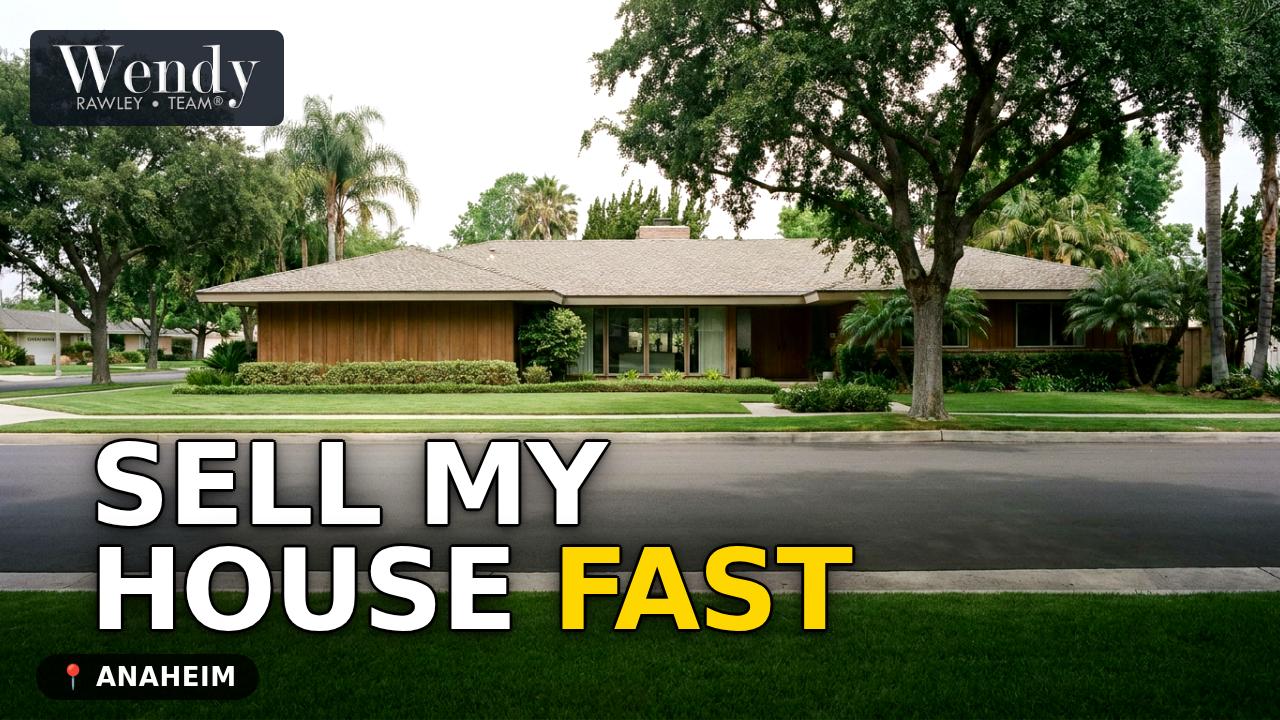
Sell My House Fast in Anaheim? Cash Offer vs. Listing on the Market
Sell My House Fast in Anaheim? Cash Offer vs. Listing on the Market
If you’re asking how to sell my house fast in Anaheim, by the end of this you’ll know what a cash sale actually skips in California, what it does not, and which path fits a house you’ve owned a long time.
Quick answer: If you want to sell my house fast in Anaheim, a cash offer can remove lender underwriting and close sooner, while listing on the open market usually reaches more buyers and tends to produce a higher price in a market where homes recently sold at about 100.64% of list price.1 Both paths usually still need a standard California closing framework: for a non-exempt transfer of single-family residential property, the statutory Transfer Disclosure Statement applies, and title/escrow, documentary transfer tax, recording, and seller tax reporting still need to be handled whether the buyer pays cash or finances.2 Cash buys speed and certainty; a listing buys exposure and competition. Which one wins depends on your timeline and price tolerance, and the real number for your home comes from closed sales in your part of Anaheim, not a citywide average.
Most people who ask us how to sell their house fast in Anaheim aren’t chasing a quick flip. They’ve owned the place a long time; the house no longer fits how they live, and the idea of a stream of showings feels like a lot. That’s a real reason to look at a cash offer. It’s also a reason to understand exactly what you’d be trading away before you sign anything.
This article compares the two paths honestly, grounded in Anaheim’s own market figures and the California statutes that bind either sale. It does not give you a tax answer, because that depends on your facts, and I’ll point you to the right professional each time the subject comes up.
Anaheim Market Snapshot
Redfin market data for Anaheim, rolling 3 months ending September 30, 2026. These are citywide all-property figures describing market conditions, not the value of any one home.
What does a cash offer actually skip in California, and what does it not?
A cash offer in Anaheim can remove the parts of a sale tied to a buyer’s loan: the appraisal, the underwriting, and the lender’s conditions. That is where the speed comes from, and it is real. Cash doesn’t excuse you from the rest of a California conveyance.
For a non-exempt transfer of single-family residential property, California Civil Code § 1102.3 requires the seller to deliver the statutory Transfer Disclosure Statement, which the Department of Real Estate publishes in its RE 6 disclosure publication, as soon as practicable and before transfer of title in a sale.2 A buyer paying cash does not make that optional. The DRE reference material describes the Civil Code § 1102.3 timing rule: deliver as soon as practicable before transfer of title, and if the disclosure arrives after the buyer makes an offer, the buyer may terminate within 3 days of personal delivery or 5 days after it is mailed.3
Title work, escrow, the documentary transfer tax, and recording the deed all still happen. California Revenue and Taxation Code § 11911 authorizes a county documentary transfer tax of $0.55 per $500, or fractional part, of consideration or value over $100, excluding liens or encumbrances remaining at the time of sale, and a qualifying city may impose a tax at half that rate, which is credited against the county tax, so the combined rate stays $0.55 per $500.4 Here’s the thing most cash pitches gloss over: “as-is” language in a contract does not erase your duty to disclose known defects. Whether a specific “as-is” clause changes anything in your situation is a question for a real estate attorney.
What cash does not waive in California?
- The statutory Transfer Disclosure Statement (published in DRE’s RE 6 disclosure publication) for non-exempt transfers of single-family residential property
- Title, escrow, and recording the deed with the county
- Documentary transfer tax under R&T Code § 11911
- Seller tax reporting, and any California withholding that applies
Should I sell my house fast in Anaheim for cash or list on the market?
A cash offer trades price for speed and certainty; a market listing trades a longer timeline and some showings for broader exposure and the chance of competing offers. In a market where 44.8% of homes recently sold above list and the sale-to-list ratio sat at 100.64%, that competition is not hypothetical.1
Use the table as a first screen: if the cash column solves a deadline problem, compare the dollar gap before you accept; if it does not, the listing column usually deserves a closer look. Neither column is “better” in the abstract. The right one depends on whether your priority is the top achievable number or a clean, predictable close.
| Factor | Cash offer | Listing on the market |
|---|---|---|
| Buyer financing risk | Removed, no lender underwriting | Present unless buyer is also cash |
| Exposure to buyers | Limited to that buyer | Full market, multiple offers possible |
| Showings and prep | Usually minimal | Staging, photos, showings |
| California disclosures (RE 6/TDS for covered, non-exempt transfers of single-family residential property) | Still required | Still required |
| Transfer tax, escrow, recording | Still apply | Still apply |
| Typical price outcome | Often below top market | Set by competition, recently near or above list citywide. |
When I sit down with an owner weighing these, my first question is never “cash or list.” It’s “What does certainty on the closing date mean to you, and what gap in price would make that certainty worth it?” That answer is personal, and it points you to the column that fits.
Anaheim pricing by housing type
- Detached houses, median sale price $1,064,5761
- Townhouses, median sale price $730,0091
- Condominiums, median sale price $654,9331
- All figures: Redfin, rolling 3 months ending September 30, 2026
How fast is the Anaheim market moving right now?
Anaheim homes recently took a median of 41 days on the market, and the city carried 3.5 months of supply with 344 homes sold in the latest rolling period.1 That is a market where a well-prepared listing is not sitting for a season. A year earlier, in the rolling 3 months ending September 30, 2025, the median was 47 days, so homes have been clearing a little quicker.1
Within the city, the pace varies by area. In the rolling 3 months ending September 30, 2026, West Anaheim homes posted a median of 36 days, East Anaheim around 42 days, and the Anaheim Colony Historic District closer to 51 days.1 Those area-level differences are a reminder to compare your home against nearby closed sales with similar age, condition, lot size, and property type rather than treating one Anaheim median as the answer.
Why does this matter to the cash-versus-list decision? When the median days-on-market figure is roughly six weeks, the time advantage of a cash sale may be smaller than many sellers assume, but you still need to add prep time and escrow timing to compare real timelines. If your home is priced against the right nearby closed sales and presented well, listing may give you a chance to test that buyer competition. If you genuinely cannot, that’s when a cash offer earns its keep.
What is your Anaheim home actually worth?
Get a free, instant estimate of your Anaheim home value and equity. No obligation. An instant estimate is a starting point, not an appraisal or a guaranteed sale price.
How do I know what my specific Anaheim home is worth?
The honest answer is that no citywide number tells you what your house is worth, because the median blends every housing type and every part of the city. Pricing a specific home comes from closed sales of comparable properties in your tract, which I can pull directly from public records and run comps for you.
The all-property citywide median of $970,000 is useful for reading market conditions, not for valuing one home.1 A detached house and a condominium can sit in very different price bands, and the property-type medians above show that spread plainly. Lot size, square footage, condition, and recent nearby sales all move your number.
If you’ve owned it a long time, you may have substantial equity, which is simply market value minus what you still owe. Equity isn’t the same as taxable gain, and high equity doesn’t mean you’ll owe tax. Whether any gain is taxable depends on your adjusted basis, your selling costs, and whether a principal-residence exclusion applies to you, which is a question for your CPA.
Getting around Anaheim: walkability and commute
How a neighborhood scores for getting around can matter to buyers weighing your home against nearby closed sales, so it is worth a plain mention here. Walk Score and transit access vary widely across Anaheim: some areas near the downtown core and the Anaheim Colony sit within walking distance of errands, while much of West and East Anaheim is more car-oriented, with daily trips handled by vehicle. If you want the specific Walk Score and transit figures for your address, Walk Score publishes them by location, and a buyer reading your listing can check them. None of these figures set your home’s value by themselves, but they are part of how a buyer frames an offer, and they are one more reason to lean on tract-level comps rather than a citywide median.
What are the tax and recording steps either way?
Both a cash sale and a listed sale follow the same California tax and recording steps, and the buyer’s payment method doesn’t change which ones apply. Use this as a handoff list: escrow/title handles recording mechanics, Wendy handles the sale strategy, and your CPA or attorney confirms tax and legal treatment for your facts.
For property-tax purposes, have escrow and the Orange County Assessor confirm whether the completed sale is treated as a change in ownership and whether any exclusion claim applies. Revenue and Taxation Code § 63.2 describes certain family-transfer exclusions “for which a claim is filed,” meaning those are claimed and documented, not automatic arm’s-length home-sale exemptions.5 An ordinary sale to an unrelated buyer is not one of those exclusions.
The documentary transfer tax is collected through recording, and R&T Code § 11912 imposes it on the person who makes or signs the taxable document, or on the person for whose benefit it is made.4 The purchase contract and escrow instructions commonly allocate who actually pays, so confirm that allocation in your signed contract. Who pays which closing cost, and the commission itself, is negotiable.
Verify these with the right office before you close
- Any family-transfer or trust exclusion, with your real estate attorney and the Orange County Assessor
- Capital-gain treatment and the principal-residence exclusion, with your CPA
- California seller withholding and any exemption or reduced-withholding certification, with your CPA or escrow/title contact for the withholding paperwork
- Current Orange County recorder fees and any Preliminary Change of Ownership Report requirement, with the Orange County Clerk-Recorder
California real-estate withholding, the exact Franchise Tax Board and IRS forms for your situation, and whether any gain exclusion applies are all things a CPA or a real estate attorney should confirm for your specific facts. Do not assume the buyer paying cash changes any of them. For financing on your next purchase, the number that matters is what you qualify for, which only a licensed mortgage loan originator can tell you.
How To Move Forward
- Name your real priority: decide whether a certain closing date or the top achievable price matters more to you, because that choice drives cash versus listing.
- Get a tract-level value: ask for comps from closed sales in your part of Anaheim rather than leaning on the citywide median.
- Keep the disclosures in view: plan on the statutory Transfer Disclosure Statement (published in DRE’s RE 6 disclosure publication) either way, and ask a real estate attorney about any “as-is” language.
- Separate equity from tax: confirm your capital-gain picture with your CPA before you assume anything about what you’d owe.
- Compare a real cash offer to a real list price: see both numbers side by side before you commit.
Common questions about selling fast in Anaheim.
Is a cash sale faster than listing in Anaheim?
A cash sale can close sooner because it removes lender underwriting and the appraisal, but the gap is narrower in a market where Anaheim homes recently took a median of 41 days to sell. Title, escrow, disclosures, and recording still take time in either path.
Does a cash buyer mean I skip California disclosures?
No, not just because the buyer pays cash. For a non-exempt transfer of single-family residential property, California Civil Code § 1102.3 requires the seller to deliver the Transfer Disclosure Statement, published by the DRE in its RE 6 disclosure publication, regardless of how the buyer pays. “As-is” language also doesn’t erase your duty to disclose known defects, which you should review with a real estate attorney.
Will I owe tax on my Anaheim home sale?
That depends on your facts, not on your equity. Taxable gain is the amount realized minus your adjusted basis, reduced by any exclusion you qualify for, so an owner with high equity can still owe little or nothing. Confirm your capital-gain treatment and any principal-residence exclusion with your CPA.
How much is the documentary transfer tax in Anaheim?
California Revenue and Taxation Code § 11911 authorizes a county rate of $0.55 per $500, or fractional part, of consideration over $100, excluding remaining liens. Anaheim Municipal Code § 2.10.020 sets a city tax of $0.275 per $500, or fractional part, which is credited against the county tax, so the combined rate for covered Anaheim transfers stays $0.55 per $500; confirm the current ordinance and the exact allocation in your signed contract and escrow instructions.
What is my specific home worth, not the citywide median?
The citywide median of $970,000 blends all housing types and all areas, so it reflects market conditions rather than valuing one home. Your number comes from closed sales of comparable homes inside your part of Anaheim, which is a direct records pull that Wendy can run for you.
Are commissions and closing costs negotiable?
Yes, commissions are negotiable, and the purchase contract and escrow instructions commonly allocate who pays the documentary transfer tax and other closing charges. Confirm every allocation in writing before you sign.
Cash offer or list your Anaheim home?
Thinking of selling? Wendy can line up a real cash offer next to a real market list price so you decide with both numbers in front of you. Already own it and just want your range? Wendy can estimate your resale range from tract-level comps instead of a citywide average.
For more Anaheim market context, see our Anaheim home page.

Wendy Rawley
REALTOR® | DRE #01898824
Wendy helps Anaheim owners compare a real cash offer against a market list price, with First Team Real Estate, at (714) 746-6355.
Over more than a decade in Southern California real estate, the Wendy Rawley Team has represented 175 home sellers and 104 buyers.6 These figures reflect prior closed transactions and do not guarantee future results.
Sources
1 Redfin, Data Center (Anaheim market data)
Citywide, by-property-type and neighborhood-level medians, days on market, months of supply, and sale-to-list figures for Anaheim, rolling 3 months ending September 30, 2026, from our maintained Redfin dataset. These are market-condition figures, not the value of any one home.
2 California DRE, Disclosures in Real Property Transactions (RE 6)
DRE’s RE 6 disclosure publication includes the statutory Transfer Disclosure Statement format and describes the TDS rules for covered, non-exempt transfers of single-family residential property under Civil Code Article 1.5 (§§ 1102 and following).
3 California DRE, Reference Book (disclosure timing)
Describes the seller’s disclosure delivery timing in a typical transaction.
4 California Revenue and Taxation Code 11911; California Revenue and Taxation Code 11912; Anaheim Municipal Code 2.10.020
Authorizes the county documentary transfer tax, identifies who is subject to the tax, and states Anaheim’s city documentary transfer tax rate, which is credited against the county tax.
5 California Revenue and Taxation Code 63.2
Describes certain family-transfer change-in-ownership exclusions that must be claimed by filing.
6 California Regional Multiple Listing Service (CRMLS)
CRMLS closed-transaction records are the source of the Wendy Rawley Team’s stated counts of 175 sellers and 104 buyers represented. Prior closed transactions do not guarantee future results.
This article is general information about selling a home in Anaheim, California, and is not legal, tax, or financial advice. Market figures are citywide and by-property-type Redfin data for Anaheim, rolling 3 months ending September 30, 2026, and describe market conditions rather than the value of any individual home. Tax and legal outcomes depend on your specific facts; confirm capital-gain and withholding questions with your CPA, legal and disclosure questions with a real estate attorney, and financing questions with a licensed mortgage loan originator. Commissions are negotiable. Nothing here guarantees a sale or a price.
The Wendy Rawley Team at First Team Real Estate, DRE #01898824, (714) 746-6355. Equal Housing Opportunity.